

Mexico murder rate vs the US: A Comparison of Crime Rates
The art of comparison – a provocative catalyst for lively and challenging dialogues. In this instance, we’re delving into the gripping subject of Mexico’s murder rate vs. the U.S. Unfurling this matter can feel like an intense, full-contact sport as we evaluate city-to-city crime rates.
Unmistakably, a city’s safety significantly impacts its residents’ quality of life. Today, we’re strapping in to dissect these crime rates, grappling with contributing elements such as the drug war, kidnappings, and the chilling reality of femicide.
The Mexico murder rate vs the US reveals a concerning trend of higher violence in Mexico, especially compared to countries like Canada, the United Kingdom, and other parts of Western Europe. Factors like gun crime, rape, and auto theft contribute to Mexico’s elevated death rate. Similar issues affect parts of Latin America—notably Brazil, El Salvador, and Honduras—where crime impacts gdp, e-commerce, and public fear. In contrast, nations like Norway, South Korea, and Australia report lower violent crime stats. Global data from Wikipedia helps compare these categories, showing how firearms and conflicts influence crime across territories.
Comparing the Crime Rate in Mexico & the U.S.
A country’s crime rate is important to its economy, societal order, and safety. While some countries, such as Mexico, have higher levels of criminality than the U.S., others have far lower levels than the average American city.
Therefore, when comparing Mexico and the U.S. directly, key factors such as geography, population size, and per capita income must be considered to predict the likelihood of crime in both nations accurately.
Regarding overall crime, recent statistics published by the World Bank show that Mexico has a much higher rate than the U.S. For example, in 2014, Mexico had over 50 homicides per 100,000 people compared to just over 4 in America.
This discrepancy can likely be linked to poverty levels, drug cartel activity, and endemic corruption in Mexico – all of which are not present to a similar extent stateside.
However, it cannot be argued that Mexico has much stricter laws regarding specific crimes such as gun ownership; guns are heavily regulated, and purchasing them in Mexico for personal use is illegal in most cases.
Geographical location and government policies
On the other hand, some areas of the U.S. may have higher crime rates than Mexico due to their geographical location and government policies toward immigration or criminal justice reform.
For example, San Francisco experiences approximately twice as many homicides per capita as any of its neighboring cities in California, likely due to its diverse population and court rulings on how people released from jail are monitored or supervised after their release.
It must also be considered that within the U.S., smaller rural areas tend to have far less criminal activity than bigger cities such as New York City or Los Angeles. Dense urban concentrations lead to various social issues, often resulting in increased levels of criminality, such as gang violence or theft from poorer households unable to defend themselves from such activities due to a lack of resources or community monitoring.
Socioeconomic structure
By looking at both figures objectively, we can see several reasons why Mexico might display higher levels of criminality than the United States. However, depending on countless variables, including socioeconomic structure or local law enforcement efficacy, spot-check areas can differ greatly between regions within either country. To delve deeper into this topic and better understand how both nations compare when considering violent crime specifically, we will explore this particular issue more thoroughly in the next section of this article…
- According to the UNHCR, Mexico has a murder rate of 16.9 per 100,000 inhabitants, making it the 15th highest in the world and seven times higher than that of the United States, as compared to Mexico’s murder rate vs the U.S.
- In 2019, Mexico City had a total of 2,200 homicides. In comparison, New York City reported 289 homicides.
- The Inter-American Development Bank estimated that in 2018, approximately 5.5 million people in Mexico were victims of some form of violent crime,
Violent Crime in Mexico Compared to the U.S.

Violent crime in Mexico is widely considered a significant issue. Data from 2019 shows that violent offenses amount to 70.6% of the crimes reported in Mexico, compared with only 8.7% in the United States. While violent crime is prevalent in both places, it’s much more frequent and severe in Mexico relative to the U.S.
Some might argue that stereotypes about safety are to blame for people’s perceptions of Mexico’s security. Furthermore, some believe these preconceived notions cause people to remain unaware of other issues like organized crime and corruption.
On the other hand, those who live in Mexican cities or have traveled there understand all too well how much of a problem violence can be in certain areas.
Though comparing Mexico to the United States on this topic is indeed difficult due to their cultural dissimilarities, it’s apparent that both countries should put more resources and effort into reducing the number of violent crimes committed each year.
This could involve lawmakers punishing perpetrators more severely, developing better monitoring systems, or increasing police presence in high-risk regions.
No matter what measures each country decides to take, there’s no denying that violence remains a challenge they must confront together if they hope to eventually improve their nations’ statuses when it comes to public safety—which is why taking a look at homicide rate comparisons between Mexican cities and their United States counterparts is an important consideration, especially for Mexico murder rate vs the U.S.
Homicide Rate Comparisons

When it comes to homicide rate comparisons, the analysis becomes more complicated than simply comparing Mexico to the United States. In Mexico, for example, most murders are committed with a firearm and perpetrated by drug cartels rather than being gang-related or involving domestic violence.
On that basis, Mexico’s homicide rate compares favorably internationally. However, when comparing homicides in cities in Mexico and the U.S., the rates can be quite different.
For instance, some cities in Mexico, such as Ciudad Juarez, have reported vastly higher homicide rates than U.S. cities in comparable economic and demographic circumstances.
With this understanding, further exploring comparative figures for other types of criminal offenses is important to understanding crime rates between cities across both countries. Thus, we will discuss robbery and burglary rates for cities in Mexico and the U.S.
Essential Information
Cross-border comparisons of homicide rates between the U.S. and Mexico can be complicated, given the differences in the causes of such crimes. Certain cities in Mexico have much higher rates of homicide than those in the U.S.
Therefore, further analysis and exploration are needed to compare better other criminal activities, such as robbery and burglary, better to understand crime rates between cities across both countries.
Robbery and Burglary Comparisons
When it comes to robbery and burglary rates, Mexico has consistently been slightly ahead of the U.S. in recent years, according to data from the United Nations Office on Drugs and Crime’s International Crime Statistics Database.
For example, in 2017, measured by incidents per 100,000 people, Mexico had 204.3 robbery incidents while the U.S. reported just 121.7. Regarding burglary cases, Mexico achieved a rate of 2,844 per 100,000 people compared with 1,924 in the U.S.
Nevertheless, from a statistical perspective, both countries face major challenges in safeguarding their citizens from robberies and burglaries. Therefore, the next section will examine drug-related crime and how Mexico and the United States deal with this ongoing problem.
Drug-Related Crimes in Mexico & the U.S.

In addition to comparing robbery and burglary rates between Mexico and the United States, it is also important to assess drug-related crime rates for a comprehensive understanding of crime across each region.
Unfortunately, no consensus exists when comparing drug-related crimes between Mexico and the United States.
For instance, The Washington Post reported that in 2016, 42,000 people died from opioid overdoses in the United States, an incredible figure that surpasses any other country in the world.
Increasing drug users
Despite this significant spike in opioid use within the United States, some experts suggest that Mexican cartels are doing better than ever due to profiting from increasing drug users.
According to research by the Government Accountability Office (GAO), Mexican cartel profits have grown exponentially since 2007 due to greater drug access and higher demand levels for various narcotics such as fentanyl and crystal methamphetamine.
With this said, we now focus on a more nuanced analysis of another form of criminal activity: marijuana offenses.
Marijuana Related Crimes
Marijuana-related crimes encompass a wide range of offenses, both federally and at the state level. In Mexico, the laws surrounding marijuana are complicated, as some states have decriminalized various forms of possession and usage while others still have harsher penalties.
Although Mexico recently passed a bill to legalize medical marijuana, recreational marijuana is still largely illegal due to federal law.
In the United States, however, each state has its own rules regarding marijuana, ranging from legalized recreational or medical use to complete prohibition. At this point, 33 states have legalized medical and recreational marijuana use.
Naturally, with different laws governing drug use on either side of the border, it stands to reason that the amount of marijuana-related crime would reflect these varying regulations.
For example, given that increased availability leads to decreased prices, which can result in even more widespread usage, one would naturally expect higher rates of marijuana-related crime in states where it is legal.
Regardless of which side of the debate you may sit on, we are beginning to understand both sides regarding legalizing marijuana.
As new research continues about associated costs vs. benefits for legal drug use within societies and nations, we’ll try to understand how medical and recreational use fits within our global communities.
We are moving on from here, then onto the next major incident that concerns most cities around the country—poverty-related crimes and their impacts on local areas.
Poverty-Related Crimes in Mexico & the U.S.

Drawing a comparison between Mexico and the United States regarding poverty-related crimes reveals some fascinating insights. First, while poverty-related corruption is not as rampant as it used to be in the U.S., Mexico continues to struggle with poverty-related crimes, even now in 2020.
Studies show that about 37% of households in Mexico (or around 19 million homes) live below the poverty line, compared to about 12% in the United States. This disparity highlights the different scales of economic hardship and its impact on crime.
It is important to consider how poverty intersects with other factors related to criminal activity, such as inadequate access to economic opportunities or quality education. This can lead impoverished individuals to seek alternative ways of making money or living, which may put them at risk of participating in activities related to drug trafficking, human smuggling, or other illegal enterprises. For example, in areas with significant poverty, higher crime rates may impact businesses and services, affecting everything from customer confidence to operational efficiency.
While poverty-related crime remains a critical issue, addressing it effectively involves understanding the diverse factors at play, including economic conditions, local businesses, and community services.

Urban vs. rural areas provides a stark contrast in terms of crime rates between Mexico and the United States. In Mexico, crime rates are far higher in urban areas than in rural ones. This has caused many cities and towns in Mexico to become violent and unsafe, even during daylight hours.
Drug cartels also have a strong presence throughout these regions, leading to increased organized crime and drug trafficking-related activity.
Primary factor
One study by MacArthur et al. (2017) found that while poverty alone is not the primary factor in high crime rates across rural parts of both countries, the economic challenges experienced by people living in those areas play a role.
The authors suggest that investment in community development initiatives and improved access to education may help reduce crime levels in these areas while providing more stable economic opportunities.
Overall, it is clear that both urban and rural areas face significant challenges when it comes to combating crime rates. While urban areas may have an advantage in access to law enforcement resources and better economic opportunities, those advantages are not always sufficient in mitigating risk levels associated with higher population density and increased opportunities for criminal activity.
Analysis of the Murder Rates: Mexico vs United States
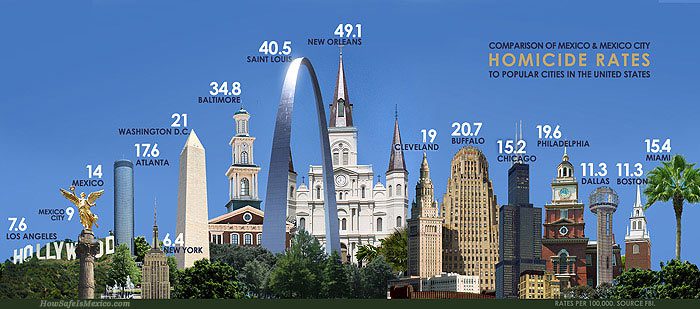
In recent years, discussions regarding safety in different countries have been at the forefront of news outlets and social media platforms, specifically focusing on the comparative analysis of murder rates. One comparison that often sparks interest is between Mexico and the United States.
Mexico, known for its rich culture and history, has unfortunately been associated with high crime rates, specifically murder. The United States, on the other hand, has had its share of safety concerns, but how do these two countries compare when it comes to murder rates?
According to data from the United Nations Office on Drugs and Crime (UNODC), as of the last available report, Mexico’s murder rate per 100,000 inhabitants is significantly higher than that of the United States.
Meanwhile, the United States, despite its lower average murder rate, is not without its safety challenges. Gun violence and other forms of crime contribute to its murder rate, with notable disparities across different states and cities. For instance, larger cities have higher murder rates than rural areas.
In conclusion, while the murder rates between Mexico and the United States show a significant difference, it’s essential to understand the complexities behind these figures.
These rates do not necessarily dictate the safety level of all regions within these countries. When visiting or moving to a new place, conduct thorough research and follow local guidelines.
FAQs
1. How do Mexico’s crime rates affect U.S. cities?
Mexico’s crime rates significantly affect U.S. cities, particularly bordering areas and communities with large immigrant populations. High levels of crime in Mexico often lead to increased cross-border migration, resulting in several social problems in the U.S.
Additionally, increased immigration can strain already limited resources, potentially creating socioeconomic inequality and poverty-related violence. Mexico’s high crime rates can also lead to social instability, directly and indirectly affecting U.S. cities.
Finally, Mexican organized crime has been linked to illicit activities in many U.S. cities, resulting in increased drug trafficking, money laundering, and other organized criminal activities. In conclusion, Mexico’s high crime rate affects citizens and U.S. cities.
2. What types of crime are most prevalent in Mexico compared to the U.S.?
In Mexico, organized crime and drug-related violence are the most prevalent types of crime. This includes kidnapping, human trafficking, racketeering, money laundering, extortion, and gun smuggling.
In contrast, the most prevalent types of crime in the U.S. are property crimes (e.g., burglary, larceny, and vehicle theft), violent crimes (e.g., robbery and assault), and white-collar crimes (e.g., fraud). Kidnapping is a particularly notable crime in Mexico.
3. Is there a significant difference between the crime rates in Mexico and the U.S.?
Yes, there is a significant difference between the crime rates in Mexico and the U.S. According to the 2017 National Survey of Security (ENS) conducted by Mexico’s Institute for Statistics and Geography, the average intentional homicide rate in Mexico was 22.8 per 100,000 inhabitants.
In comparison, according to 2017 statistics from the Federal Bureau of Investigation in the U.S., intentional homicide was 5.3 per 100,000 inhabitants.
This reflects an incredibly wide gap in overall safety between the two countries. Additionally, kidnapping is more prevalent in Mexico than in the U.S., with Mexico experiencing higher crime incidents.
Mexico’s crime rates have been a matter of concern for authorities and have made headlines globally. Tourist destinations such as Cancun, popular among millions of visitors from around the world, including the United States, have seen an increase in violence and criminal activity.
4. What is the murder rate comparison between Mexico and the U.S.?
Mexico generally has a higher murder rate compared to the United States. However, the specific rates can vary depending on the region and the timeframe being analyzed.
5. Why does Mexico have a higher murder rate than the U.S.?
Several factors contribute to Mexico’s higher murder rate, including drug-related violence, organized crime, socioeconomic disparities, and challenges in law enforcement and governance.