
Michoacán Mexico: Culture, Nature & Top Attractions
You’re about to explore Michoacán, a Mexican region where history, culture, and nature intertwine. Imagine vibrant Purépecha heritage meeting stunning colonial architecture while the economy thrives on agriculture, especially avocados. Despite organized crime challenges, the area’s natural wonders like Lake Pátzcuaro and the Monarch Butterfly Biosphere Reserve remain enchanting. Traditional crafts flourish, offering a unique blend of old and new. Curious about how Michoacán balances its cultural richness with modern dynamics?
Key Takeaways
- Michoacán is renowned for its agricultural output, leading the world in avocado production.
- The region is famous for its cultural heritage, including the artistic traditions of the Purépecha people.
- Morelia, the state’s capital, is a UNESCO World Heritage Site known for its colonial architecture.
- Natural attractions like the Paricutín volcano and Monarch Butterfly Biosphere Reserve draw tourists yearly.
- Michoacán faces challenges with narcotics-related violence impacting safety and migration.
Historical Context of Michoacán

While exploring the historical context of Michoacán, you’ll discover its rich roots, beginning with the Purépecha Empire, a formidable pre-Hispanic civilization that once rivaled the Aztecs.
This empire thrived until the early 16th century, when the Spanish conquest, led by Nuño de Guzmán, dramatically changed the region’s trajectory. The conquest ushered in colonial governance and the spread of Christian missions, particularly through the efforts of Vasco de Quiroga in the 1530s.
As you investigate deeper, you’ll find that Michoacán’s significance continued beyond the Spanish conquest. In 1824, it became one of Mexico’s original states.
Its capital, Morelia, formerly Valladolid, stands as a UNESCO World Heritage Site. The region’s history also ties closely to the Mexican War of Independence, highlighting its enduring legacy.
Geographical Features and Natural Attractions
Michoacán boasts a stunning array of geographical features and natural attractions that captivate visitors and locals alike.
In Michoacán de Ocampo, you’ll find the majestic Sierra Madre del Sur, providing a dramatic backdrop with its towering peaks and volcanic activity. One of the most notable is the Paricutín volcano, a marvel recognized globally.
Don’t miss Lake Pátzcuaro, a serene spot steeped in cultural significance, offering traditional fishing experiences and picturesque views.
The Monarch Butterfly Biosphere Reserve is another highlight, where millions of monarch butterflies create a mesmerizing spectacle during migration.
Additionally, the state’s rivers, such as the Lerma, Balsas, and Tepalcatepec, weave through the landscape, supporting both agriculture and diverse ecosystems.
Michoacán’s natural beauty is truly unparalleled.
Economic Activities and Industries

When you explore Michoacán’s economy, you’ll notice agriculture takes center stage with avocados and strawberries leading the charge.
Tourism also plays a vital role, drawing you to stunning sites like Lake Pátzcuaro and the Monarch Butterfly Biosphere Reserve.
Don’t overlook the mining sector, where valuable resources like gold and silver are extracted, adding depth to the state’s economic landscape.
Agriculture and Key Crops
In Michoacán, agriculture stands as a cornerstone of the state’s economy, with key crops like avocados, strawberries, and grains leading the charge.
You’re in a region that’s one of the largest avocado producers globally, making this fruit a significant contributor to agricultural income. The state’s diverse climate and fertile soils allow for the cultivation of tropical fruits, legumes, and coffee.
Traditional methods blend with modern techniques to boost yield and sustainability, though challenges like limited investment and environmental issues pose risks.
- Avocado Production: A world leader in exportation.
- Strawberries: Another crucial crop thriving here.
- Grains Are Essential to local diets and economies.
- Diverse Techniques: Mix of traditional and modern practices.
Explore Michoacán’s rich agricultural tapestry.
Tourism and Cultural Sites
As you explore Michoacán, you’ll find that its tourism industry thrives on a rich tapestry of historical and cultural sites. The UNESCO World Heritage Site of Morelia captivates with its colonial architecture, while eight Pueblos Mágicos, like Tlalpujahua and Santa Clara del Cobre, offer unique cultural experiences. The vibrant Day of the Dead celebrations in Janitzio and Pátzcuaro attract thousands of enthusiastic people to immerse themselves in tradition.
Lake Pátzcuaro provides a picturesque setting for boating and cultural exchanges. Local artisans showcase their skills, contributing to the economy.
Here’s a glimpse of Michoacán’s cultural attractions:
| Attraction | Highlight | Economic Impact |
|---|---|---|
| Morelia | Colonial architecture | Tourism boost |
| Janitzio | Day of the Dead celebrations | Visitor influx |
| Lake Pátzcuaro | Boating and artisan markets | Economic contributions |
| Tlalpujahua | Pueblo Mágico with a rich heritage | Cultural tourism |
| Santa Clara del Cobre | Coppersmithing and crafts | Local economy support |
Mining and Natural Resources
While Michoacán enchants with its cultural wonders, it also thrives on a robust mining industry. As a significant economic activity, mining provides essential resources like gold, silver, iron, copper, zinc, and sulfur, fueling local employment and income.
Mining hotspots like Angangueo, Tlalpujahua, and Inguaran have historically defined the region’s economy. Despite its economic contribution, mining’s impact is overshadowed by agriculture and services. However, the state’s rich tapestry of natural resources, including petroleum and minerals, remains crucial.
Still, challenges persist, such as environmental concerns and the urgent need for sustainable practices in resource extraction.
Here are some key points to reflect upon:
- Mining shapes local economies but needs sustainable practices.
- Agriculture surpasses mining in economic contribution.
- Environmental concerns challenge resource extraction.
- Natural resources are integral to Michoacán’s economy.
Cultural and Artistic Heritage
When you explore Michoacán, you’ll notice the rich tapestry of indigenous artistic traditions that the Purépecha people proudly preserve.
The state’s colonial architecture adds another layer, showcasing the European influence that blends seamlessly with local styles.
As you wander through towns and Pueblos Mágicos, the fusion of these elements creates a unique cultural landscape that’s both enchanting and inspiring.
Indigenous Artistic Traditions
Explore the heart of Michoacán, where the Purépecha people’s artistic traditions vividly express their cultural identity.
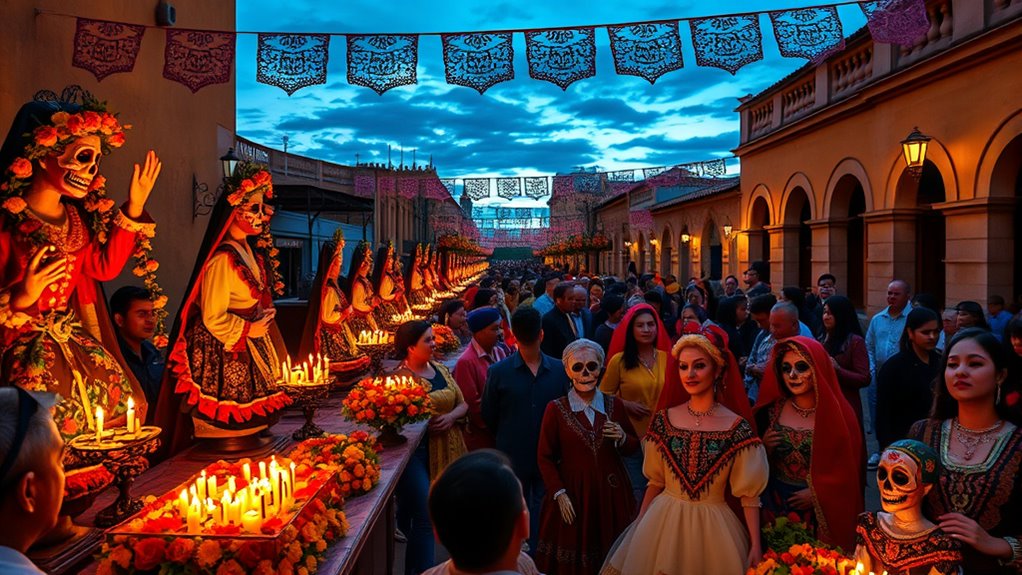
You’ll discover their exquisite craftsmanship in every corner, particularly in wood carving, pottery, and textiles. The Day of the Dead celebrations are a visual feast, featuring colorful papel picado and altars adorned with handmade crafts, paying homage to loved ones.
Michoacán’s artistic heritage isn’t just limited to these traditions. The region is celebrated for its copper crafts, especially in Santa Clara del Cobre, where artisans create stunning pieces using age-old techniques.
Local festivals further showcase this rich culture through music and the lively Danza de los Viejitos.
- Purépecha craftsmanship
- Day of the Dead artistry
- Copper crafts in Santa Clara
- Danza de los Viejitos
Colonial Architecture Influence
Although Michoacán is renowned for its vibrant indigenous traditions, the region’s colonial architecture also plays an essential role in its cultural and artistic heritage. Morelia, the capital, is a UNESCO World Heritage Site celebrated for its well-preserved colonial architecture. As you wander through Morelia’s historic center, you’ll encounter over 1,000 colonial-era buildings, including the magnificent Morelia Cathedral, with its pink stone facades, a hallmark of baroque style.
The blend of European and local styles is evident, reflecting indigenous influences adapting to European designs. This architectural legacy attracts tourists and scholars alike, offering insights into Mexico’s history.
| Landmark | Style | Significance |
|---|---|---|
| Morelia Cathedral | Baroque | Iconic pink stone facades |
| Historic Center | Colonial architecture | UNESCO World Heritage Site |
| Churches & Convents | Colonial with local mix | Cultural and religious centers |
Migration Trends and Challenges
While Michoacán has a vibrant culture and rich history, it’s also known for its significant migration trends and challenges. Migration to the United States has long been a pathway for many seeking better opportunities.
Remittances play an essential role, with US$2.2 billion sent back in 2014, making up 10% of the state’s GDP. Yet, violence from narcotics-related crime has blurred the lines between voluntary and forced migration. This has led to an increase in forcibly displaced persons.
Consider these key points:
- Asylum petitions from Mexican nationals rose from 3,669 in 2000 to 14,643 in 2016.
- Low acceptance rates in the US complicate migration efforts.
- Economic challenges drive return migration, often with limited job prospects.
- Authorities lack thorough policies for internally displaced persons.
Educational Evolution and Contributions

Since its early days, Michoacán has been a crucial region for educational development in Mexico, beginning with the establishment of the Seminario Conciliar in 1601. This institution evolved into the Colegio de San Nicolás, integrating philosophy and civil law.
By the mid-19th century, it was secularized, embracing changes that mirrored the era’s societal shifts and fostering connections with historical figures from the Mexican War of Independence.
You’ll notice that Michoacán’s educational institutions expanded their curricula, focusing on sciences essential to agriculture, mining, and industry. These areas greatly boosted the state’s economic growth.
The architecture of these institutions blends indigenous and European styles, acting as centers for cultural exchange.
Educational reforms post-1917 further altered these institutions from religious to secular frameworks.
Municipalities and Local Governance
As Michoacán’s educational institutions have evolved, so too has its approach to local governance, reflecting a rich tapestry of history and progress. The state is divided into 113 municipalities, each with its own unique challenges and strengths.
These municipalities, governed by elected municipal presidents and councils, are tasked with providing essential services. Morelia stands out as the largest by population, boasting 849,053 residents. In contrast, Zináparo is the smallest, with just 3,232 people.
- Arteaga: Largest by land area at 3,434.40 km².
- Aporo: Smallest by land area, covering only 58.40 km².
- Tarímbaro: Experienced a notable population growth of 45.6%.
- Essential services: Include water, sewerage, and environmental protection.
Each municipality enriches Michoacán’s diverse governance landscape.
Safety and Crime Dynamics

How has Michoacán become a focal point of concern for safety and crime? The state is plagued by narcotics-related violence, with organized crime syndicates challenging state authority.
This battle for control has led to increased insecurity, making daily life risky for residents. The emergence of self-defense militias, formed to combat these criminal organizations, has further destabilized the region.
Thousands have been displaced, seeking refuge in makeshift camps due to ongoing violence. In 2020, Michoacán was among Mexico’s states with the highest homicide rates, fueled by cartel conflicts.
The state’s inability to support internally displaced persons highlights the significant challenges facing vulnerable populations. The dramatic rise in asylum petitions underscores the profound impact of this insecurity on Michoacán’s residents.
Conclusion
You’ve explored Michoacán’s rich tapestry of history, culture, and natural beauty. From the vibrant Purépecha heritage to stunning attractions like Lake Pátzcuaro, Michoacán captivates every visitor. Despite facing challenges from organized crime, the region thrives with its booming avocado industry and traditional craftsmanship. As you investigate its educational and municipal dynamics, you’ll find a community resilient and evolving. Michoacán stands as a symbol of Mexico’s diverse and enduring spirit, inviting you to experience its unique charm.
FAQs
1. What Is Michoacán, Mexico, Known For?
You’re curious about a place known for vibrant Day of the Dead celebrations, stunning colonial architecture, and rich culinary traditions. It’s also famous for its Monarch Butterfly Biosphere Reserve and unique artisanal crafts found in Pueblos Mágicos.
2. Are People From Michoacán Aztec or Mayan?
You’re wondering if people from there are Aztec or Mayan. They’re actually primarily Purépecha. This indigenous group was a distinct civilization with its own culture and history, separate from both the Aztecs and Mayans.
3. What Is the Religion in Michoacán?
You’ll find that the predominant religion is Roman Catholicism, with vibrant festivals celebrating faith. Many Indigenous communities blend traditional beliefs with Catholic practices, creating unique expressions. Protestantism and other movements are present but less widespread.
4. What Are the Top Three Cities in Michoacán?
You’re curious about the top three cities. Morelia stands out with its colonial charm. Uruapan thrives on avocados and natural beauty. Zamora impresses with its agriculture and historic sites. These cities truly define the region’s essence.