

Virgen de Guadalupe: The History and Significance in Mexico
The Virgen de Guadalupe is a powerful symbol in Mexico, stemming from a cherished story. This story began in 1531 when, as belief tells us, the Virgin Mary appeared to Juan Diego, a native man on Tepeyac Hill.
The event was brushed off as unreal until evidence appeared: an image of the Virgin herself imprinted on Juan Diego’s cloak—a sight so touching like the Catholic bells ringing at dawn in an old Mexican city. Now, let’s dive into the details of this story.
The Virgen de Guadalupe has immense cultural and religious importance in Mexico. It led to widespread conversions and an enduring legacy that shaped Mexican identity.
History of the Virgen de Guadalupe

The history of the Virgen de Guadalupe dates back to when Mexico was under Spanish rule, and Catholicism had firmly taken root in the region.
The account begins in December 1531, when, according to the story, the Virgin Mary made a series of miraculous appearances to an indigenous man named Juan Diego.
These apparitions occurred on the hill of Tepeyac, enduringly significant as a sacred site in Mexican history and a testament to the enduring cultural fusion that characterizes modern-day Mexico.
Once overlooked as mere mythology, the accounts of these apparitions have garnered an unwavering influence across Mexican Catholicism and its broader cultural identity.
The Virgin of Guadalupe has become more than just a religious symbol; she embodies a profound connection between the Catholic faith and indigenous traditions.
Cultural Synthesis
This chapter in Mexican history unfolded during a time of great cultural exchange, simultaneously marked by the Spanish conquest and the indomitable spirit of indigenous cultures.
The image attributed to this apparition amplifies the significance—an iconography encapsulating both Spanish and pre-Hispanic elements. This image resonates deeply with believers and non-believers alike, attesting to its irrefutable hold on Mexican culture.
Symbolic Representation
Beyond its religious import, the manifestation of the Virgen de Guadalupe has etched her place as an enduring figure in Mexican art, literature, music, and beyond.
Whether it’s depicted in murals adorning churches, portraying her role as Empress of the Americas, or featured in contemporary artwork celebrating her patronage, her visual representation is virtually ubiquitous across Mexico.
In addition to its aesthetic significance, the symbolism extended to Our Lady of Guadalupe carries far-reaching cultural implications. She represents hope, resilience, and unity—a revered figure transcending religious contexts and capturing the collective ethos woven into Mexico’s social fabric.
As we delve deeper into the tale of Juan Diego and the apparitions, we continue exploring the enduring narrative that has left an indelible mark on Mexican culture and faith.
Tale of Juan Diego and the Apparitions
The account of Juan Diego’s encounter with the Virgin Mary is pivotal to the enduring significance of the Virgin de Guadalupe in Mexico. As he traversed the rugged terrain, a radiant figure appeared before him, speaking in his native Nahuatl language.
To his astonishment, it was none other than the revered Virgin Mary herself. Her ethereal presence filled him with awe and reverence. Intriguingly, this wasn’t an isolated apparition.
However, undeterred by doubt and disheartening remarks, Juan Diego obediently returned to Tepeyac Hill as guided by the Virgin Mary.
The Virgin Mary granted Juan Diego a miraculous sign to substantiate his remarkable encounter. His unfurling his tilma before Archbishop Zumárraga and revealing the heavenly roses within made for an even more spectacular sight.
These profound moments have etched themselves into history books and continue to shape Mexico’s spiritual identity today. Now, let’s step inside the hallowed grounds of the Basilica de Guadalupe to witness firsthand where this extraordinary narrative unfolded.
Inside the Basilica de Guadalupe
Stepping into the grandeur of the Basilica de Guadalupe in Mexico City feels like entering a realm where history, faith, and art converge.
The basilica houses the iconic image of the Virgen de Guadalupe on Juan Diego’s tilma, a simple yet powerful expression of divine intervention and cultural significance.
The time is a coarse, cactus-fiber cloak that became an extraordinary canvas for a miraculous image. This iconic artifact takes center stage within the basilica, drawing visitors worldwide to bask in its presence.
Spiritual Ambiance
The atmosphere inside the basilica exudes a tranquil solemnity, fostering an environment for contemplation and reverence. The air reverberates with whispered prayers and devout murmurs, weaving together a tapestry of reverence that spans centuries.
Iconic Image
The iconic image itself is a marvel to behold. Its rich color palette and intricate details seem to breathe life into the vision of Our Lady of Guadalupe. Her serene countenance radiates warmth and compassion from afar, drawing worshippers close to seek solace and guidance.
It’s truly remarkable to witness how this centuries-old symbol continues to unite and inspire communities through its unwavering presence in the basilica. The image is not merely an object of veneration; it represents a timeless bond between divinity and humanity.
Pilgrimage Site
The basilica’s significance as a pilgrimage site cannot be overstated. Millions of pilgrims embark on journeys to pay homage to Our Lady of Guadalupe each year, seeking enlightenment, solace, or divine intervention.
They arrive with hearts full of hope and prayers on their lips, searching for spiritual renewal or perhaps to connect with an enduring cultural legacy.
Virgen de Guadalupe in Mexican Faith and Traditions
The Virgen de Guadalupe holds a special place in the hearts of millions of Mexicans and those who identify with Mexican culture. She’s hailed as a figure of unity, comfort, and national pride, intertwining religious faith and cultural identity.
The Virgen de Guadalupe feast day celebration on December 12th is a highlight in Mexican culture. Processions, musical performances, and vibrant displays of devotion at churches and public spaces across Mexico mark it. Families unite to honor her, creating an atmosphere of love, hope, and community spirit.
Her presence isn’t limited to religious spaces—it extends far beyond. You’ll see her image adorning various items, from keychains to posters, prominently displayed in homes, businesses, and public transport. Her ubiquity is a constant reminder of her role as a source of protection and hope for all.
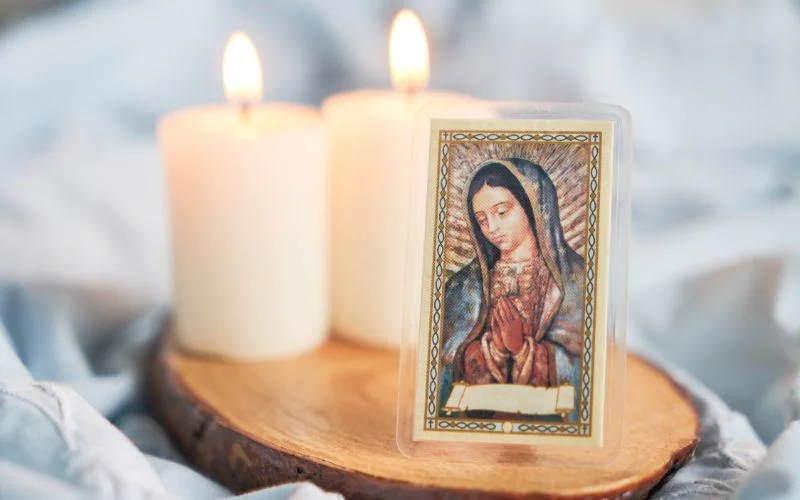
You’ll often find an altar or shrine dedicated to the Virgin de Guadalupe in countless Mexican households. Lit candles, flowers, and reverence surround this sacred space, symbolizing veneration and faith while fostering a deep connection between families and their spirituality.
It’s not just about religious devotion; it goes much deeper than that. The story of the Virgen de Guadalupe apparition to Juan Diego carries tremendous cultural significance.
For many Mexicans, it represents resilience, faith, and hope in challenging times. The empathy she embodies resonates profoundly with the struggles and triumphs integral to Mexican history.
The profound impact of the Virgen de Guadalupe goes beyond symbolism; it weaves into every aspect of Mexican life. Let’s now delve into an analysis of her multi-faceted symbolism and its enduring impact.
Analyzing the Virgin’s Symbolism

The significance of the Virgen de Guadalupe for the people of Mexico extends beyond religious veneration. Her image is steeped in profound symbolism that resonates deeply with cultural, historical, and spiritual dimensions. The themes of compassion, maternal love, and spiritual guidance are at the heart of this symbolism.
The story of her appearance to Juan Diego and her role as a motherly figure contributes to her continued relevance in the lives of many Mexicans.
It’s important to understand that representing the Virgin Mary as a mestiza—a woman of mixed European and indigenous descent—carries profound implications. Her appearance in indigenous attire and with native features symbolizes an integration of cultures.
This syncretism was crucial when Spanish colonial rule was dominant, signifying resistance and fusion. It became a motif of unity, blending Catholic beliefs with indigenous spirituality and affirming Mexico’s complex identity.
The moon at her feet symbolizes both celestial and earthly elements. In Aztec mythology, the moon goddess Coatlicue was believed to be associated with fertility and creation.
This symbolism in Guadalupe’s image subtly acknowledges pre-Columbian beliefs intertwined with Christianity. It represents a harmonious blend of past and present, indigenous traditions, and Catholicism.
Furthermore, the radiating rays envelop her and reflect a celestial aura, signifying divinity and grace. This ethereal quality is juxtaposed against the humbleness of Juan Diego’s encounter and provides a visual representation of spiritual transcendence.
This divine illumination is an emblem of hope, representing an enduring source of comfort for believers amidst adversity.
Just as importantly, the colors used in the iconic image contribute greatly to its symbolic power. Her pink tunic robe symbolizes mercy, while her cerulean mantle embodies protection—themes deeply ingrained within Mexican culture. The symbolism surrounding the Virgen de Guadalupe spans cultural, religious, and historical realms.
The Catholic Church and Guadalupe
The history of the Catholic Church and its relationship with the Virgin de Guadalupe is intertwined with the very fabric of Mexico’s spiritual identity.
Since the 16th century, when the Basilica of Our Lady of Guadalupe was constructed, the Church has played a pivotal role in promoting and propagating the veneration of the Virgen de Guadalupe.
Recognizing her significance in Mexican culture as a powerful religious symbol, the Church has officially acknowledged the Virgin’s appearance to Juan Diego and her image on his cloak.
The Catholic Church has elevated the Basilica of Our Lady of Guadalupe to a place of pilgrimage for believers worldwide.
The impact of this endorsement can be seen in how deeply ingrained the Virgen de Guadalupe is within Mexican culture. Her influence extends beyond religion, permeating art, folklore, music, and national identity.
In summary, the Catholic Church’s acknowledgment and promotion of the Virgen de Guadalupe have cemented her status as a cherished icon in Mexican Catholicism, emphasizing her role as one of immense cultural and spiritual significance.
Devotional Practices and the Virgen de Guadalupe

Processions, prayers, and celebrating her feast day on December 12th are just a few examples of these rich devotional practices that reflect her enduring impact on the spiritual lives of many. This article will explore these practices and their significance.
The spiritual attachment toward the Virgen de Guadalupe goes beyond religious symbolism; it permeates cultural and national identity.
The Virgen de Guadalupe’s impact has extended far beyond Mexico into other parts of Latin America. It has even gained recognition in different parts of the world with Latino diaspora communities.
The magnitude of her influence has prompted scholars to explore how she has become a symbol of religious devotion and an embodiment of cultural identity for many.
In conclusion, the widespread devotional practices associated with the Virgen de Guadalupe are an integral part of Mexican culture and an expression of faith, unity, and heritage.
Regardless of individual beliefs, it is undeniable that her influence continues to shape spiritual and cultural landscapes far beyond the boundaries of religion.
Miraculous Events Surrounding the Virgin of Guadalupe
The story goes that in December 1531, Juan Diego’s uncle, Juan Bernardino, was gravely ill. Seeking a cure for his illness, Juan Diego received a series of divine interventions from the Virgen de Guadalupe herself.
The Miraculous Image
Additionally, the most iconic miracle associated with the Virgen de Guadalupe is imprinting her image on Juan Diego’s tilma (cloak). According to the narrative, a picture of the Virgin appeared when Juan Diego unfolded his tilma in front of Archbishop Zumárraga.
This miraculous image affirmed the authenticity of Juan Diego’s encounters and became a powerful symbol of faith and divine intervention.
Impact on Faith and Culture
The miracles associated with the Virgin of Guadalupe have profoundly impacted Mexican culture. Stories and accounts of healings and intercessions attributed to her have permeated society, cementing her status as a figure of unwavering devotion and miraculous intervention.
Countless individuals have reported experiencing personal miracles, healings, and unexplainable phenomena after praying to the Virgin de Guadalupe, adding layers to her significance as a divine figure in people’s lives.
The undeniable impact of these miraculous events lies in their ability to forge unshakable faith, inspire hope, and foster enduring devotion to the Virgin of Guadalupe across generations.
The unparalleled relevance and influence of the Virgin of Guadalupe in Mexico are testaments to the enduring power of faith and divine intervention. Her presence continues to inspire devotion and serve as a symbol of hope for millions.