
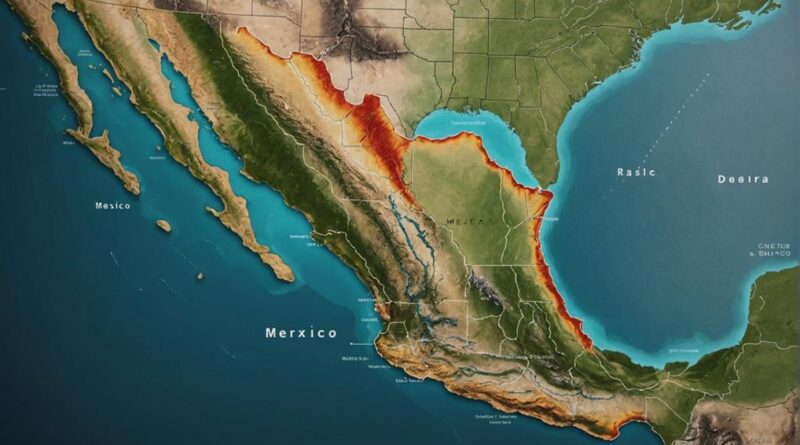
Which Country Has More Land Mexico or the United States?
When comparing the land area of Mexico and the United States, you might initially think they’re somewhat similar, but the difference is quite substantial. The United States spans about 9.83 million square kilometers, dwarfing Mexico’s 1.96 million square kilometers. This disparity isn’t just about numbers; it influences everything from geographic diversity to economic resources. Alaska alone almost matches Mexico’s total area, underscoring the vastness of the U.S. But how does this land distribution impact population densities and regional development? There’s a lot more to unpack.
Key Takeaways
- The United States has approximately 9.83 million square kilometers.
- Mexico covers around 1.96 million square kilometers.
- The United States is about five times larger than Mexico.
- Alaska alone is nearly as big as Mexico.
- Historical land expansions contributed to the United States’ larger size.
Land Area Comparison

When comparing land area, the United States dwarfs Mexico with its vast expanse of approximately 9.83 million square kilometers. In contrast, Mexico covers around 1.96 million square kilometers. This stark difference highlights just how much larger the United States is when it comes to land area. To put it into perspective, the United States is about five times larger than Mexico.
Interestingly, even Alaska, the largest state in the United States, is nearly as big as Mexico by itself. Alaska’s vast wilderness and sprawling landscape showcase the sheer size disparity between the two nations. While Mexico’s land area of approximately 1,964,375 square kilometers is substantial on its own, it pales in comparison to the United States’ massive territory.
This significant difference in land area between the United States and Mexico underscores the geographic scale at which these two countries operate. The United States’ expansive territory allows for a diverse range of environments and resources, further emphasizing its land area advantage.
When you look at the numbers, the United States undeniably has a much larger total land area, making it a giant compared to Mexico’s more modest size.
Geographic Diversity
Mexico and the United States each boast a stunning array of geographic features that highlight their unique landscapes. As two of the largest countries in North America, they offer an incredible range of environments. In Mexico, you’ll find vast deserts, lush rainforests, and towering mountain ranges. This country’s geographic diversity is one of its most enthralling attributes.
The United States, on the other hand, spans an even greater variety of terrains due to its larger land area. From the icy expanses of Alaska, which is nearly as large as Mexico itself, to the arid deserts of Arizona and Nevada, the U.S. showcases a broad spectrum of natural wonders. The country’s geographic diversity is further enriched by its extensive coastlines along both the Atlantic and Pacific Oceans.
Here’s a quick rundown of their geographic highlights:
1) Mexico:
- Deserts like the Sonoran and Chihuahua
- The Sierra Madre mountain ranges
- Coastal regions along the Gulf of Mexico and the Pacific Ocean
2) United States:
- The Rocky Mountains and Appalachian Mountains
- The Great Plains and Mississippi River Basin
- Diverse climates from tropical Florida to arctic Alaska
Both countries’ varied geographies make them fascinating places to explore.
Population Distribution
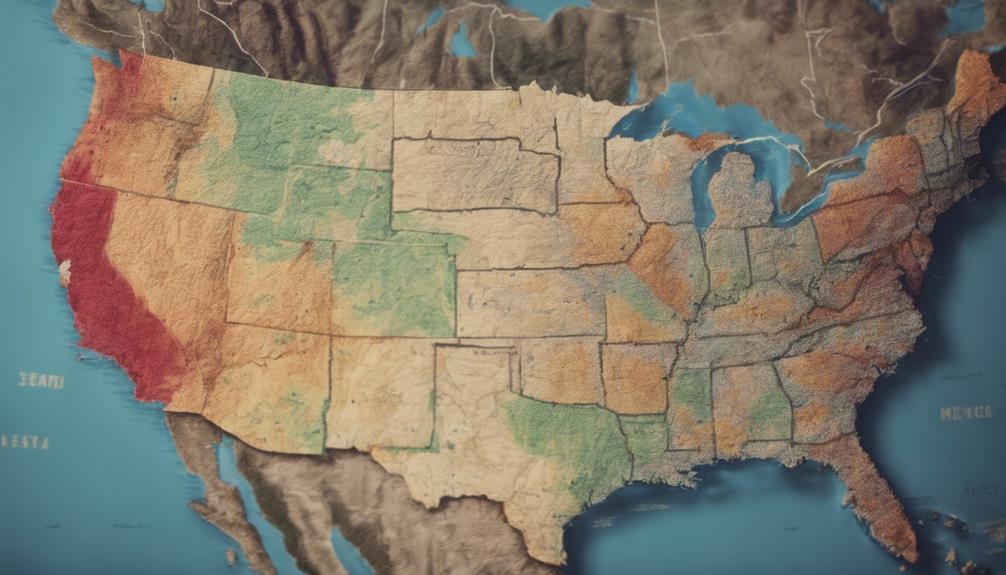
Population distribution in Mexico and the United States reveals intriguing patterns shaped by geography and urbanization.
In Mexico, you’ll find a higher population density compared to the United States. The population is mostly concentrated between Jalisco and Veracruz, with a significant quarter residing in and around the bustling metropolis of Mexico City. This makes Mexico City a densely populated hub, driven by its economic and cultural significance.
In contrast, the United States exhibits a more varied settlement pattern. Large urban clusters dominate the eastern regions, where cities like New York and Chicago draw millions. However, the western mountainous areas are sparsely populated, highlighting the geographical diversity that influences where people choose to live.
Understanding these population distribution trends is essential.
In Mexico, the concentration around Mexico City demands focused urban planning to manage resources and infrastructure effectively.
Meanwhile, in the U.S., the contrast between densely populated urban centers and sparsely populated rural areas poses unique challenges and opportunities for regional development.
Economic Resources
Considering these population distribution trends, it’s evident that the United States’ larger land area greatly enhances its economic resources and opportunities compared to Mexico. With a size nearly five times that of Mexico, the U.S. benefits from a diverse range of climates and geographical features that contribute to its robust economy.
Firstly, the vast land area supports agriculture on a massive scale. The U.S. produces significant amounts of corn, wheat, and soybeans, which are key economic resources. This agricultural abundance creates a wealth of opportunities for farmers and related industries.
- Agriculture: The U.S. leads in the production of essential crops like corn, wheat, and soybeans.
- Natural Resources: The land area includes extensive mineral deposits, forests, and water resources, promoting industries like mining and forestry.
- Infrastructure Development: The vast expanse allows for diverse infrastructure projects, from highways to high-tech industrial zones.
Additionally, the extensive natural resources found across the U.S. land area, such as oil, natural gas, and minerals, drive economic growth and provide energy security.
Historical Land Changes
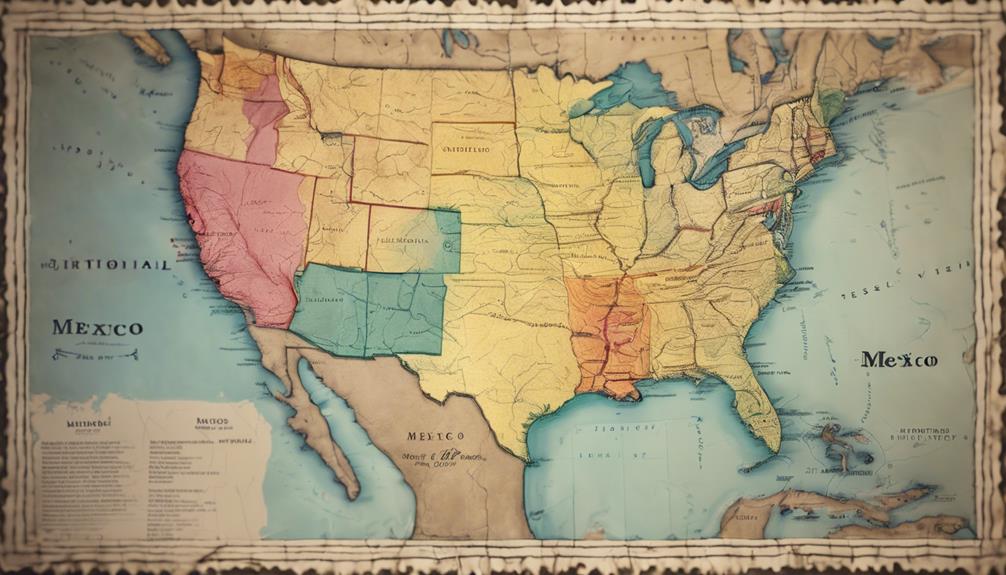
Throughout history, territorial changes have dramatically shaped the land areas of both the United States and its southern neighbor. The United States has undergone notable land area changes, primarily through territorial expansion. One of the most remarkable expansions was the Louisiana Purchase in 1803, which nearly doubled the size of the U.S. This was followed by the annexation of Texas in 1845 and the acquisition of territories from Mexico after the Mexican-American War in 1848, including present-day California, Arizona, and New Mexico.
Mexico, on the other hand, experienced substantial loss of land due to these events. Before the Mexican-American War, Mexico’s geographical boundaries included much of the present-day southwestern United States. The Treaty of Guadalupe Hidalgo in 1848 resulted in Mexico ceding a vast portion of its territory to the U.S., significantly reducing its land area.
These historical land area changes underscore the disparity in landmass between the two countries. The United States’ territorial expansion has contributed to its status as one of the largest countries in the world, while Mexico’s loss of territory has cemented its place as considerably smaller in comparison.
Impact on Development
The substantial difference in land size between Mexico and the United States profoundly impacts their economic development and resource distribution. With the U.S. being about five times larger, it enjoys a broader range of opportunities for diverse economic activities and regional development. This vast land area influences key aspects such as population distribution, urbanization, and agricultural productivity.
Firstly, the population distribution in the United States is more spread out, allowing for the development of numerous urban and rural areas. In contrast, Mexico’s smaller land area leads to denser population centers, particularly in cities like Mexico City.
Secondly, the urbanization process differs significantly. The U.S. has the space to develop multiple large metropolitan areas, each becoming an economic hub. Mexico, on the other hand, faces challenges with overcrowded cities, which can strain infrastructure and services.
Lastly, agricultural productivity benefits greatly from the U.S.’s vast land. Large-scale farming operations in states like California and Texas produce a variety of crops, supporting both domestic consumption and exports. Mexico, while agriculturally productive, deals with limitations due to less available arable land, impacting overall output.
Frequently Asked Questions
What Country Has the Most Land?
When you’re looking at the country with the most land, you’d be talking about Russia. Its size is massive, covering about 17.1 million square kilometers.
While Antarctic territory isn’t owned by any one country and isn’t counted in national totals, it’s also huge.
The Canadian expanse is impressive too, at around 9.98 million square kilometers, but it’s still far smaller than Russia.
What Country Is Richer Mexico or USA?
When considering which country is richer, the USA or Mexico, you should look at the economic disparity and GDP comparison.
The United States has a much higher GDP, making it wealthier overall. However, income inequality exists in both countries.
While Mexico is an important trading partner and has diverse industries, the US’s larger population and stronger economy contribute to its greater wealth.
How Big Is Mexico in Comparison to the US?
You may wonder about Mexico’s size compared to the USA. Geographical boundaries clearly show the USA is 401% larger than Mexico.
Despite its smaller size, Mexico’s population density is higher in urban areas. Mexico’s land utilization is diverse, from deserts to forests, but the USA’s vast land allows for varied utilization, including agriculture and urban development.
Understanding these aspects helps grasp the scale differences between the two nations.
Which Is Bigger, Alaska or Mexico?
When comparing Alaska’s geography to Mexico’s terrain, you’ll find that Mexico is slightly bigger. Mexico’s land area is about 1.96 million square kilometers, while Alaska covers around 1.72 million square kilometers.
Historically, both regions have played significant roles in North America. Alaska features vast wilderness and rugged landscapes, whereas Mexico boasts diverse terrains from mountains to coastlines.
Conclusion
To sum up, it’s evident that the United States has a much larger landmass compared to Mexico, providing a wide variety of geographic landscapes, economic resources, and population distribution.
This extensive land area has facilitated historical territorial expansions and has played a significant role in the country’s growth.
When comparing the two countries, it’s clear that the sheer size of the United States gives it a distinct advantage in many aspects over Mexico.