
History and Significance of Zapopan: History, Culture, and Devotion
You’re about to explore the fascinating journey of Zapopan, a place where ancient roots intertwine with Spanish influences. Imagine walking through its streets, feeling the vibrant pulse of its history. The Virgin of Zapopan, a symbol of cultural fusion, still draws crowds for annual pilgrimages. From pre-Hispanic origins to modern urban life, Zapopan’s story is one of resilience and transformation. Curious about how it harmonizes tradition with progress? There’s much more to discover. Learn more about the History and Significance of Zapopan.
Pre-Hispanic Origins and Early Settlements
Before the Spanish arrived, Zapopan was a vibrant region where various indigenous groups like the Zapotec, Nahua, Maya, and Aztecs converged, forming the Tecos community.
These pre-Hispanic origins reflect a rich tapestry of cultures and traditions. The indigenous peoples worshipped a deity known as Teopintzintl, or The Child God, illustrating their spiritual life before the Spanish conquest. This cultural diversity laid the groundwork for Zapopan’s complex history.
In 1530, the Spanish, led by Nuño de Guzmán, initiated a conquest that dramatically altered the region.
The subsequent Mixtón War of 1541 depopulated the area, prompting Spanish repopulation efforts. Despite these changes, Zapopan’s pre-Hispanic roots continue to influence its cultural identity, showcasing resilience and adaptation over centuries.
Spanish Conquest and Colonial Transformation
When the Spanish, led by Nuño de Guzmán, arrived in Zapopan in 1530, they initiated a transformative period marked by colonial domination.
The Spanish conquest altered the region’s cultural landscape, replacing indigenous traditions with European influences. Fray Antonio de Segovia played a pivotal role in this transformation by introducing the image of Our Lady of Zapopan in 1541. This religious icon became central during the colonial period, symbolizing the blending of cultures.
Following the Mixtón War, Zapopan faced depopulation, prompting Spanish efforts to repopulate the area to strengthen their hold. These changes solidified Zapopan’s position as a key colonial entity, culminating in its designation as a department seat in 1824, underscoring its political importance in Jalisco’s history.
Emergence of the Virgin of Zapopan
The emergence of the Virgin of Zapopan, known affectionately as La Pacificadora, marked a significant cultural and spiritual development for the region. Fray Antonio de Segovia gifted the statue to the town on December 8, 1541. This representation of the Virgin Mary under the Immaculate Conception quickly became central to the area’s cultural identity.
Recognized as miraculous by Bishop Don Juan Ruiz Colmenero in 1653, the Virgin of Zapopan was invoked for protection against epidemics and storms. Her influence extends to an annual pilgrimage from June 13 to October 4, where devotees visit various churches in Guadalajara.
Canonically crowned by the Vatican in 1919, the Virgin’s significance in the Catholic faith and Jalisco’s cultural identity is undeniable.
Religious and Cultural Celebrations
Although the Virgin of Zapopan holds deep religious significance, the celebrations surrounding her are vibrant cultural events that draw people from across the region.
The annual procession on October 12 is a highlight, attracting thousands to honor the Virgin Mary. You’ll find traditional food, dancing, and festivities that create an unforgettable atmosphere.
The Basilica of Our Lady serves as the heart of these celebrations, emphasizing her role as the Patroness of Guadalajara. From June 13 to October 4, pilgrims accompany the statue of Our Lady of Zapopan to various churches, reinforcing her religious importance.
The Zapopan Festival, initiated in 2005, adds another layer with workshops and performances by Mexican artists, drawing crowds of up to 800,000 each year.
Architectural Landmarks and Historical Sites
While exploring Zapopan, you can’t miss its remarkable architectural landmarks and historical sites that tell tales of its rich heritage.
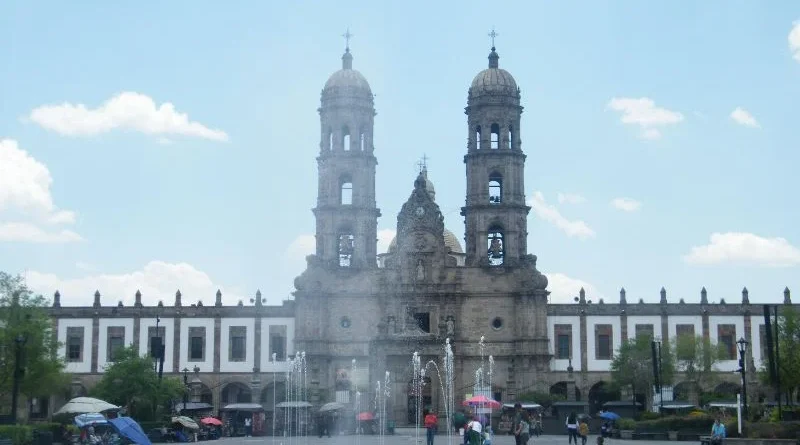
Start at the Basilica of Zapopan, constructed between 1689 and 1892, and recognized as a basilica by Pope Pius XII in 1940. Its religious significance is profound.
Next, visit the Temple of San Pedro Apóstol, showcasing stunning colonial architecture and serving as a key cultural hub.
As you enter the city, the Arco de Ingreso a Zapopan welcomes you with its symbolic presence.
Don’t skip the Municipal Palace, where the La Revolución Universal mural vividly recounts the Mexican Revolution.
Finally, enjoy the Plaza Civica, marked by a towering flagpole and bronze eagle, celebrating Zapopan’s historical legacy.
Demographic and Urban Development

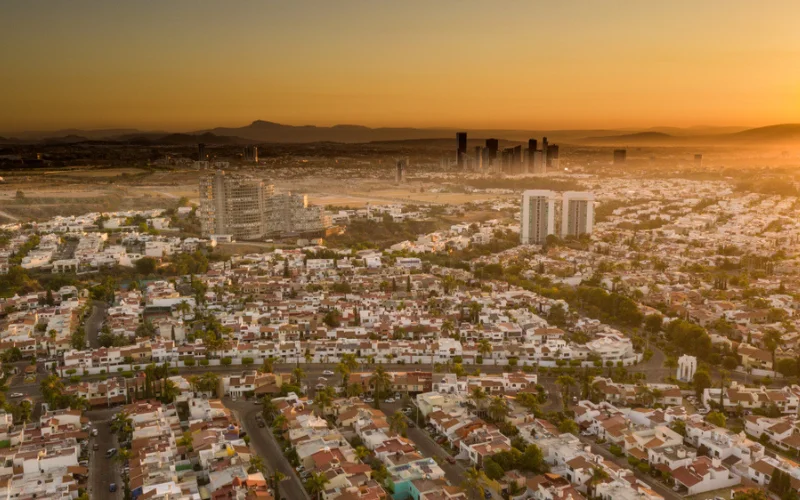
Despite its historical roots, Zapopan has rapidly transformed into a vibrant urban center. As of the 2020 census, its population soared to about 1,257,547, making it the most populous municipality in the state of Jalisco.
This urban expansion is largely fueled by its strategic location within the Guadalajara Metropolitan Area, turning Zapopan into a prime suburban hub for families and professionals. The city covers 893.15 km², featuring predominantly flat terrain at elevations between 1,500 and 2,000 meters above sea level.
Zapopan’s development boasts a harmonious blend of residential, commercial, and cultural spaces, reflecting a diverse community. Here, modern living and traditional heritage coexist, illustrating the dynamic growth and urbanization that define Zapopan today.
Economic Growth and Modernization
As Zapopan continues to modernize, it’s become a vital economic powerhouse in the region, driven largely by its strategic location near Guadalajara. This proximity fuels economic growth, turning the city into a commercial and manufacturing hub.
You’ll find a robust production of agricultural products, like corn, sugarcane, and cotton, playing a crucial role in its economy. With a population increase from 1,143,168 in 2010 to 1,257,547 in 2020, Zapopan’s urban expansion reflects its thriving development.
Economic activities are further enhanced by tourism, livestock, and apiculture, creating a diversified economic landscape. Investments in modern infrastructure and transportation systems have also contributed to this growth, improving accessibility and supporting businesses and residents alike.
Conclusion
You’ve journeyed through Zapopan’s rich tapestry, from its pre-Hispanic roots to the vibrant urban center it is today. The Spanish conquest reshaped its cultural essence, while the Virgin of Zapopan remains a beacon of blended traditions. As you explore its historical sites and partake in lively celebrations, you’ll feel the harmonious blend of past and present. Zapopan’s dynamic growth and modernization continue to honor its heritage, making it a unique and significant cultural hub.