

10 Interesting Facts About Mexico: Discover the Land of Wonders
When you think of Mexico, you might picture vibrant festivals or stunning beaches, but there’s much more to discover. Mexico’s geographic diversity spans from arid deserts to lush jungles, providing a unique backdrop for its rich cultural heritage and historical significance. You’ll find UNESCO World Heritage Sites alongside bustling cities that drive its economy. Have you ever wondered about Mexico’s literary giants or its passion for sports? And what about its biodiverse wildlife and iconic national symbols? These elements combine to create a nation full of intriguing stories waiting to be explored. Learn more about 10 Interesting Facts About Mexico.
Key Takeaways
- Mexico has 35 UNESCO World Heritage Sites, showcasing its rich cultural and natural heritage.
- Mexican cuisine uniquely blends indigenous and Spanish influences, featuring tacos, tamales, and mole dishes.
- The Day of the Deadayestival highlights Mexico’s vibrant traditions and celebration of life and death.
- Mexico’s diverse geography includes deserts, mountains, jungles, and stunning coastlines like Cancun and Riviera Maya.
- The ancient civilizations of the Aztecs and Maya significantly shaped Mexico’s cultural and historical landscape.
Geographic Diversity

You’ll find a fascinating mix of deserts, mountains, and jungles when exploring Mexico’s geographic diversity. This diverse landscape is one of Mexico’s most enthralling features. From the arid expanses of the Sonoran Desert to the lush, tropical rainforests of the Yucatan Peninsula, Mexico’s geography offers a wide array of environments. Each region supports unique ecosystems, contributing to the country’s rich biodiversity.
The towering Sierra Madre mountain ranges offer breathtaking vistas and are home to numerous species of plants and animals found nowhere else in the world.
In contrast, the dense jungles provide a habitat for exotic wildlife and ancient ruins that tell the story of Mexico’s past. This varied geography supports a remarkable range of biodiversity, making Mexico a haven for nature enthusiasts and adventurers alike.
Don’t forget the stunning beaches that line Mexico’s coastline. Destinations like Cancun and the Riviera Maya boast some of the world’s most beautiful beaches, perfect for relaxation or water sports.
Meanwhile, natural wonders like the Copper Canyon invite you to further explore Mexico’s diverse landscapes. Whether hiking, diving or simply soaking in the scenery, Mexico’s geographic diversity offers something for every traveler.
Rich Cultural Heritage
You’ll find a rich cultural heritage shaped by indigenous civilizations and Spanish colonization in Mexico.
Traditional Mexican cuisine, like tacos and tamales, reflects this blend of influences.
Festivals such as Day of the Dead and vibrant Mariachi music showcase the country’s deep-rooted traditions.
Indigenous Civilizations’ Legacy
Although modern Mexico is a vibrant fusion of cultures, its legacy of ancient indigenous civilizations truly sets it apart. The Aztecs, Maya civilization, and Olmecs, among other Mesoamerican cultures, have left an indelible mark on Mexico’s cultural landscape.
The remnants of the Aztec capital city, Tenochtitlán, show their influence. They built a highly organized society with intricate social, political, and religious structures. Their architectural marvels and sophisticated engineering still amaze historians and tourists alike.
The Maya civilization excelled in art, architecture, and especially astronomy. They developed incredibly accurate calendars that even surpassed the European Julian calendar. When you visit ancient Maya cities like Chichen Itza or Tikal, you can’t help but be awed by their towering pyramids and detailed carvings. Their advancements in mathematics and writing systems are a tribute to their intellectual prowess.
The Olmecs, often considered the “mother culture” of Mesoamerica, are famous for their colossal stone head sculptures. These artistic and architectural achievements laid the foundation for future cultures. Their influence is evident in the traditions and practices of later Mesoamerican societies, making them a cornerstone of Mexico’s rich heritage.
Spanish Colonial Influence
The influence of ancient native civilizations is undeniably profound, but Mexico’s rich cultural heritage also owes much to Spanish colonial impact. When you explore Mexico, you’ll notice how Spanish colonization has left an indelible mark on the country’s culture.
Traditional Mexican cuisine, for instance, blends Spanish ingredients like wheat and dairy with native foods such as corn and chili peppers, creating a unique fusion of flavors.
Spanish architecture is unmistakable in Mexican cities. Colonial churches, grand haciendas, and cobblestone streets showcase the elegance and durability of Spanish design. These structures are a testament to the country’s historical journey and cultural blend.
Spanish influence is equally significant in the domain of art. Mexican murals and religious paintings often combine Spanish artistic techniques and native themes, telling stories that resonate with the country’s complex identity.
Furthermore, Spanish is the most widely spoken language in Mexico, a lasting legacy of Spanish colonization. It’s a means of communication and a fundamental element of Mexico’s national identity. So, while native roots run deep, the Spanish colonial impact is integral to Mexico’s rich cultural tapestry.
Historical Significance

You can’t talk about Mexico’s historical significance without mentioning its independence from Spain, which began on September 16, 1810, and was formalized by the Treaty of Córdoba in 1821.
Fast-forward to 1910, the Mexican Revolution shook the nation, leading to major social reforms and a new constitution.
Let’s not forget the ancient civilizations, such as the Aztecs, Mayans, and Olmecs, which have left an indelible mark on Mexico’s cultural identity.
Independence From Spain
September 16, 1810, marks a pivotal moment in Mexican history when the cry for independence rang out, signaling the start of a decade-long struggle against Spanish colonial rule. TDay day, Day to de Dolores, saw Father Miguel Hidalgo rally Indigenous and mestizo peasants to rise against Spanish rule, igniting the Mexican War of Independence. Hidalgo’s impassioned call for freedom set the stage for a fierce and prolonged conflict that would eventually end Spanish dominance in Mexico.
Mexican revolutionaries’ determination to seek liberation throughout the war drove countless battles and skirmishes. The conflict culminated in 1821 with the signing of the Treaty of Córdoba, officially recognizing Mexico as an independent nation after over 300 years of Spanish rule. This monumental victory is commemorated yearly on Mexican Independence Day, September 16, honoring the heroes and events that secured Mexico’s freedom.
| Event | Date |
|---|---|
| Grito de Dolores | September 16, 1810 |
| Start of War of Independence | 1810 |
| Treaty of Córdoba | 1821 |
| End of Spanish Rule | 1821 |
Through resilience and courage, Mexico’s quest for independence transformed the nation’s destiny.
Mexican Revolution Impact
Marking the centennial of Mexico’s independence, the Mexican Revolution erupted in 1910 and became the first social revolution of the 20th century. This revolution wasn’t just about changing leaders; it aimed for profound social and political change.
One of the most significant outcomes was the Constitution of 1917, which introduced vital reforms, including land redistribution and labor rights, creating a more inclusive and equitable society.
The revolution also led to the emergence of the PRI party, which dominated Mexican politics for much of the 20th century. This party played a pivotal role in shaping the country’s political landscape and ensuring the changes sought during the revolution were implemented.
The Mexican Revolution left a lasting impact on Mexican society. Here are four key points to remember:
- Social Reforms: The Constitution of 1917 addressed land redistribution and labor rights.
- Political Landscape: The PRI party dominated Mexican politics for decades.
- Inclusivity: The changes led to a more inclusive government, representing a broader spectrum of society.
- Cultural Shifts: The revolution inspired a sense of national identity and unity.
These changes helped pave the way for modern Mexico, illustrating the revolution’s enduring significance.
Ancient Civilizations’ Legacy
Mexico’s rich history is deeply influenced by its ancient civilizations, including the Aztecs, Maya, and Olmecs. These civilizations have left a remarkable legacy that continues to captivate you today.
The Aztec capital, Tenochtitlán, was a marvel of urban planning with advanced water management systems. Imagine walking through the bustling streets of this thriving city, where canals and aqueducts efficiently manage water resources.
Mayan astronomers were equally impressive, developing a precise calendar system rivaling the Julian calendar. Their astronomical knowledge was extraordinary, helping them predict celestial events and create a sophisticated understanding of time. You can still see the remnants of their achievements in the grand pyramids and observatories scattered across the Yucatán Peninsula.
The Olmecs, often considered the “mother culture” of Mesoamerica, are renowned for their colossal stone head sculptures. These artistic and cultural feats provide a glimpse into their advanced society. As you explore Mexico, you’ll encounter these monumental artifacts, each telling a story of the Olmecs’ significant contributions.
These ancient civilizations’ legacies aren’t just relics of the past but living testimonies to Mexico’s rich cultural heritage.
Economic Powerhouse
As an economic powerhouse, Mexico is the 15th largest economy in the world by nominal GDP. This impressive ranking is a sign of the strength of the Mexican economy, which is driven by various industries and strategic trade partnerships. One of the key sectors bolstering this economic might is manufacturing. Mexico is a major producer of automobiles and electronics, making it an essential player in global supply chains.
Tourism also plays a crucial role in Mexico’s economic landscape. The country’s rich cultural heritage, stunning beaches, and vibrant cities attract millions of visitors yearly, contributing significantly to economic growth.
In addition, agriculture remains vital, with Mexico being a top producer of avocados and tomatoes. These agricultural products feed its population and generate substantial export revenues.
To visualize Mexico’s economic strengths, consider these key points:
- Manufacturing: Major global producer of automobiles and electronics.
- Tourism: Significant contributor to economic strength through extensive tourist attractions.
- Agriculture: Leading producer of avocados and tomatoes.
- Trade Partnerships: Strategic alliances with countries worldwide, enhancing economic stability.
Biodiverse Wildlife

Mexico’s incredible biodiversity means you’ll find many animal habitats, from lush rainforests to arid deserts. Unique endemic species like the axolotl and vaquita call these diverse landscapes home.
Mexico has enacted various conservation efforts to protect this natural wealth, ensuring the preservation of these species and their habitats for future generations.
Diverse Animal Habitats
With its remarkable range of ecosystems, Mexico boasts an impressive 10-12% of the world’s biodiversity, positioning it as the fourth most biodiverse country globally. Mexico is home to diverse animal habitats that showcase its rich biodiversity.
The variety is astounding, from dense rainforests teeming with spider monkeys and ocelots to arid deserts where unique plant and animal species have adapted to harsh conditions. Along the Baja California coast, gray whales migrate to breed, creating a unique natural spectacle that attracts visitors and researchers alike.
Here’s a quick look at Mexico’s diverse animal habitats:
- Rainforests: These lush areas are rich in wildlife, including colorful macaws and elusive jaguars, providing a haven for countless species.
- Deserts: Mexico’s northern deserts host a range of specially adapted plants and animals, showcasing nature’s resilience in extreme environments.
- Coastal Waters: The Baja California coast is famous for gray whale migrations and offers unique animal habitats for marine life.
- Mountains and Highlands: These regions support diverse flora and fauna, creating microhabitats that sustain various species.
Unique Endemic Species
Explore Mexico’s unique endemic species and uncover some of the planet’s most fascinating creatures. Take the axolotl, for instance. This critically endangered salamander, also known as the Mexican walking fish, can regenerate its body parts and stay in its juvenile form throughout life. It can be found only in the waterways of Xochimilco, near Mexico City.
Another remarkable species is the vaquita marina, the world’s smallest porpoise. Unfortunately, it’s on the brink of extinction, with fewer than ten individuals in the upper Gulf of California. This tiny porpoise’s plight highlights the urgent need for protecting Mexico’s diverse wildlife.
Don’t miss the volcano rabbit or zacatuche. This small, fluffy rabbit thrives near volcanic activity in Mexico’s mountainous regions. Its ability to live in such harsh environments makes it a unique species.
Lastly, there’s the Mexican gray wolf, once nearly extinct. Thanks to dedicated efforts, it’s been successfully reintroduced into the wild in northern Mexico. Each endemic species showcases Mexico’s rich biodiversity and ecological importance, making it a crucial area for conservation and study.
Conservation Efforts Enacted
Conservation efforts in Mexico prove the country’s dedication to preserving its rich biodiversity. Mexico has implemented various initiatives to protect its biodiverse wildlife, including iconic species like spider monkeys, ocelots, and vibrant macaws. These efforts aim to safeguard the country’s impressive 10-12% share of the world’s biodiversity, ensuring that future generations can continue to marvel at its unique ecosystems.
To give you a clear picture of Mexico’s commitment, here are some key conservation strategies:
- Protection of Natural Habitats: Mexico prioritizes the preservation of crucial ecosystems, such as rainforests and wetlands, which are home to countless species.
- Sustainable Practices: The country promotes environmentally friendly agriculture, fishing, and tourism to minimize human impact on wildlife.
- Endangered Species Programs: Specific initiatives focus on recovering and protecting endangered species, ensuring their survival and continued presence in the wild.
- Community Involvement: Local communities play a significant role in conservation efforts, participating in and benefiting from sustainable practices that promote ecological balance.
Vibrant Festivals
Among Mexico’s most enchanting cultural elements are its vibrant festivals, which burst with color, music, and tradition. One of the most iconic celebrations is the Day of The Dead (Día de los Muertos), where you honor deceased loved ones with altars and offerings, transforming cemeteries into places of joy and remembrance.
Another well-known festival, Cinco de Mayo, celebrates Mexican heritage and pride, particularly commemorating the Battle of Puebla in 1862.
The Guelaguetza festival in Oaxaca is a must-see. It showcases traditional dances, music, and colorful costumes, vividly displaying the region’s rich cultural heritage.
On September 16, Mexico’s Independence Day (Día de la Independencia), the country comes alive with parades, fireworks, and delicious traditional food like chiles en nogada. This Day marksDayxidays freedom from Spanish rule and is celebrated with unmatched enthusiasm.
Semana Santa (Holy Week) is another significant festival deeply rooted in religious traditions. During this time, you can witness processions, reenactments, and various cultural events highlighting the community’s spiritual essence. These festivals offer a window into Mexico’s rich cultural tapestry, inviting you to immerse yourself in its traditions.
Literary Contributions
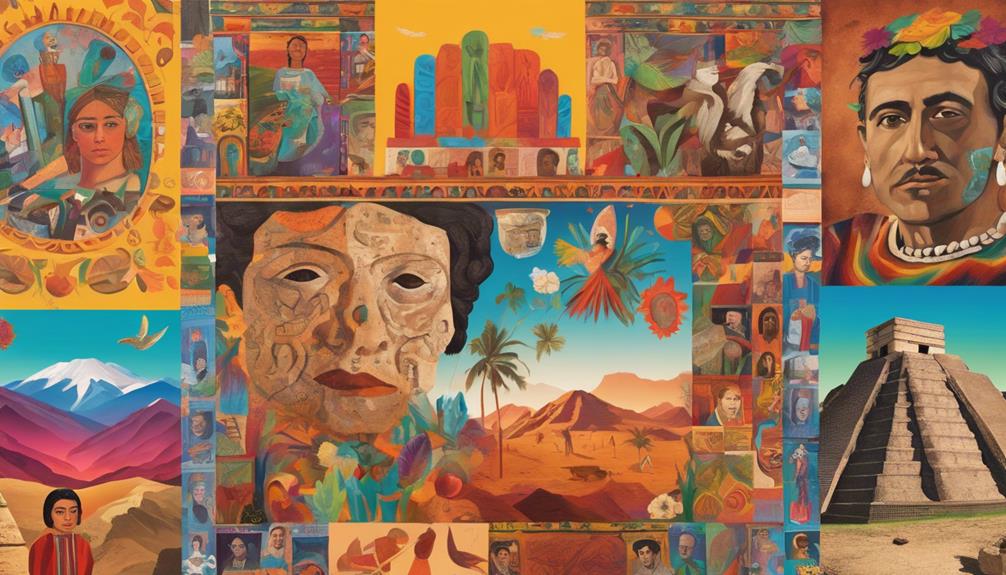
While Mexico’s festivals are captivated by their vibrancy and cultural richness, their literary contributions offer another dimension of richness. Mexican literature reflects the country’s cultural wealth and historical depth, evident in the works of its most acclaimed authors. Octavio Paz, a Nobel Prize-winning poet, essayist, and diplomat, is a towering figure in Mexican literature. His profound works explore the intricacies of Mexican identity, culture, and history.
Another literary giant, Juan Rulfo, is celebrated for his novel “Pedro Páramo,” a cornerstone of magical realism. This masterpiece immerses readers in a haunting, surreal world, showcasing the unique storytelling style that characterizes Mexican literature. These authors, among others, have solidified Mexico’s position on the global literary stage.
Here are some notable points about Mexican literature:
- Octavio Paz: Awarded the Nobel Prize in Literature in 1990 for his profound literary contributions.
- Juan Rulfo is known for “Pedro Páramo,” a seminal work in magical realism.
- Cultural Wealth: Mexican literature mirrors the country’s diverse cultural heritage.
- Historical Depth: The narratives often delve into Mexico’s complex history, adding meaning to their stories.
Explore Mexican literature to immerse yourself in a vibrant tapestry of cultural and historical narratives.
Passion for Sports
When it comes to sports, Mexico’s passion is palpable and diverse. Soccer, known locally as fútbol, reigns supreme with an incredibly dedicated fan base. You can feel the excitement during matches for local teams or the national squad. The crowd’s roar, the wave of green jerseys, and the collective cheer for every goal make soccer an integral part of Mexican culture.
But soccer isn’t the only sport that captures hearts in Mexico. Baseball has a strong following, especially in the northern regions. The sport showcases Mexico’s diverse sports culture, with local leagues and enthusiastic fans celebrating every home run.
Don’t forget about lucha libre, Mexican professional wrestling. This sport is a spectacle of colorful masks, acrobatics, and dramatic storylines that attract audiences worldwide. Watching a lucha libre match is an unforgettable experience that blends athleticism and entertainment.
Boxing also holds a special place in Mexican sports culture. Legends like Julio Cesar Chavez and current champions like Canelo Alvarez highlight Mexico’s significant contribution to the boxing world. These sports entertain and unite people through shared passion and competition, making them an essential part of Mexico’s vibrant culture.
UNESCO Heritage Sites

Mexico’s UNESCO World Heritage Sites reflect the country’s rich cultural and historical legacy. With 35 designated sites, Mexico proves its diverse history and cultural heritage. These sites range from ancient pyramids to colonial towns and natural parks, each contributing to the country’s historical significance and global recognition.
When you explore Mexico’s UNESCO World Heritage Sites, you’ll encounter an array of cultural and natural wonders. Here are four notable examples:
- Chichen Itza: This ancient Mayan city in Yucatán is famed for its iconic pyramid, El Castillo, and showcases the advanced knowledge of Mayan civilization.
- Historic Center of Mexico City and Xochimilco: This area combines Aztec and Spanish influences and includes colonial buildings, floating gardens, and the remains of Tenochtitlan.
- Puebla: Known for its baroque architecture, this colonial town offers a glimpse into Mexico’s rich history and the fusion of European and indigenous cultures.
- Monarch Butterfly Biosphere Reserve: This natural park highlights Mexico’s biodiversity and attracts millions of monarch butterflies yearly.
UNESCO recognition not only preserves these sites but also underscores Mexico’s cultural and historical importance on a global scale.
National Symbols
National symbols are pivotal in expressing Mexico’s rich cultural heritage and national identity. One of the most iconic national symbols is the Mexican flag, which features a striking image of an eagle perched on a cactus, devouring a snake. This powerful image symbolizes the foundation of Mexico City, rooted deeply in Aztec mythology.
The same imagery is incorporated into the National Emblem of Mexico, where the eagle, serpent, and prickly pear cactus tell the legendary tale of the Aztecs’ search for a new homeland.
The golden eagle, Mexico’s national bird, also holds significant cultural importance. Revered in Mexican folklore, this majestic bird represents strength and resilience. It is prominently displayed in various national contexts, reflecting the country’s values and spirit.
Another unique symbol is La Catrina, the elegantly dressed skeletal figure synonymous with Día de los Muertos. La Catrina serves as a poignant reminder of Mexico’s deep respect for and celebration of life and death, capturing the essence of this vibrant tradition.
Lastly, the National Anthem of Mexico, “Mexicanos, al grito de Guerra,” composed in 1853, echoes the nation’s proud history and enduring values. These national symbols collectively tell Mexico’s rich and multifaceted story.
Conclusion
In exploring Mexico’s geographic diversity, rich cultural heritage, and historical significance, you’ve uncovered a nation brimming with life and stories. From its economic prowess and biodiverse wildlife to its literary giants and sports fervor, Mexico captivates at every turn. Its unique idea UNESCO sites and iconic symbols like the Mexican flag and La Catrina reveal its distinctive identity. There is much more to discover, so keep diving into Mexico’s wonders and let its magic inspire you.
FAQs
1. What Are 7 Interesting Facts About Mexico?
Mexican cuisine is UNESCO-recognized, and Mexican traditions are deeply rooted in its diverse culture. Mexican history includes the Aztecs and Maya, with landmarks like the Great Pyramid of Cholula and 35 UNESCO World Heritage Sites.
2. What Are 5 Interesting Facts About Mexico City?
You’ll love Mexico City’s rich history, colorful architecture, and vibrant markets. Immerse yourself in its cultural heritage while savoring culinary delights. Despite challenges, this city remains a must-visit hub of activity and fascination.
3. What Are 10 Interesting Facts About New Mexico?
You’ll love New Mexico for its folklore legends, diverse cuisine, and rich indigenous tribes. Explore historical ruins and stunning natural landscapes. The state’s unique blend of cultures and history makes it truly enchanting.
4. What Is So Special About Mexico?
You’ll love Mexico’s cultural diversity, vibrant cuisine, and rich history. The stunning landscapes and colorful traditions make it truly special. From ancient ruins to delicious food, Mexico offers an unforgettable experience that captures the heart.