
10 World-Famous Paintings by Mexican Artists: Canvas Chronicles
Mexican art has a rich and diverse history that spans centuries, featuring many talented artists who have left their mark on the global art scene. From the vibrant colors of the Aztecs and Mayans to the iconic works of the Mexican muralists, Mexican art has a unique and powerful presence.
In this article, we will explore the ten most famous paintings by Mexican artists that have significantly contributed to the art world.
These artworks not only showcase the talent and creativity of Mexican artists but also reflect the country’s rich cultural heritage and complex history.
“The Two Fridas” by Frida Kahlo

“The Two Fridas” is a surreal and striking self-portrait that features two identical Frida Kahlos seated on a bench against a stormy, cloudy background. Each Frida is dressed in distinct clothing, symbolizing different aspects of her identity and heritage.
The Frida on the left is dressed in a traditional Mexican Tehuana costume, representing her connection to Mexican heritage and indigenous roots. She wears a flowing red skirt, a white blouse adorned with lace, and a pre-Columbian-style necklace.
Her heart is exposed, and it appears to be broken, with an artery torn and bleeding. The symbolism of the exposed heart suggests emotional pain and vulnerability.
She holds surgical scissors, which she uses to cut the artery that leads to the broken heart of the other Frida. This imagery conveys a sense of self-surgery and self-healing, as well as the idea that Frida is trying to sever her emotional connection and pain.
Between the two Fridas, there is a visible vein connecting their hearts, creating a powerful visual metaphor for the emotional and physical connection between her two selves.
Historical Context: Frida Kahlo created “The Two Fridas” during a turbulent period in her life. She was dealing with physical pain and undergoing multiple surgeries due to injuries sustained in a bus accident as a teenager. Additionally, her marriage to the famous Mexican muralist Diego Rivera was going through a difficult phase, marked by infidelity and personal struggles. All these factors contributed to the emotional depth and complexity of the painting.
In Conclusion, “The Two Fridas” is a profoundly introspective and emotionally charged work of art that continues to captivate viewers with its symbolism, vulnerability, and exploration of identity.
It is a testament to Frida Kahlo’s artistic genius and her ability to convey her innermost thoughts and emotions through her art.
“Man at the Crossroads” by Diego Rivera

The mural is a large-scale fresco measuring approximately 22 feet high and 63 feet wide. The mural is highly detailed and densely packed with various symbolic elements, historical figures, and contemporary themes.
Key elements and figures in the mural include:
The Central Figure: The central figure is a muscular male worker holding a hammer and a sickle, symbolizing the unity of labor and industry. He is surrounded by swirling, dynamic lines that give a sense of movement and energy.
Rays of Light: Radiating from the central figure, there are rays of light that symbolize enlightenment and progress.
Social and Political Themes: The mural addresses social and political issues of the time, referencing class struggle, imperialism, and capitalism. It also highlights the importance of education and the role of the working class in shaping the future.
Controversy: Despite the artistic merits of “Man at the Crossroads,” the mural became the center of a heated controversy. Rivera, in response to this censorship, refused to make the changes and chose to leave the project.
Destruction of the Mural: After Rivera’s departure, the mural was covered with a plain wall and later destroyed in 1934. The wall was eventually replaced by a mural created by the American artist José Clemente Orozco, another prominent Mexican muralist.
In Conclusion, “Man at the Crossroads” by Diego Rivera was a groundbreaking mural that addressed complex social and political themes of its time. Despite its destruction, it remains an important part of art history and a symbol of artistic expression and controversy.
“The Flower Carrier” by Diego Rivera
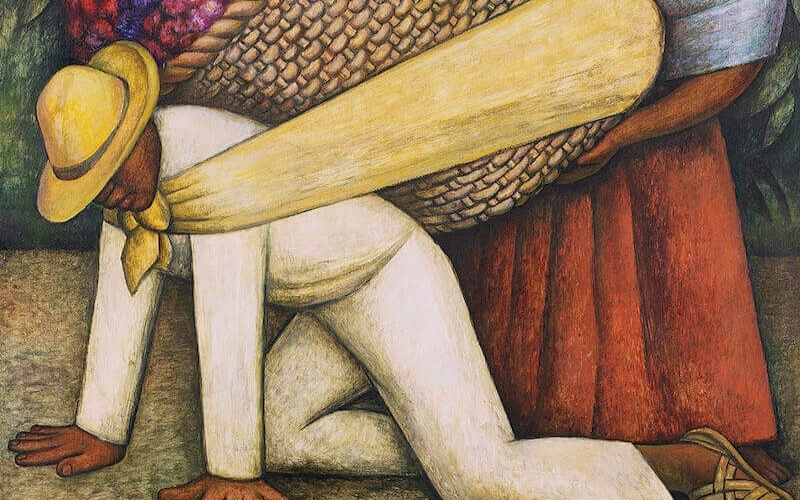
“The Flower Carrier” depicts a laborer, commonly known as a “cargador,” carrying a massive bundle of flowers on his back. The bundle of flowers consists of vibrant, colorful blooms, including sunflowers, marigolds, and other varieties commonly associated with Mexican culture.
This anonymity allows the viewer to project their feelings onto the laborer, evoking empathy and a sense of shared humanity.
The background of the painting is relatively simple, with earthy tones and a bland landscape. This minimal background directs the viewer’s attention to the laborer and the flowers, highlighting the central themes of the artwork.
Symbolism: “The Flower Carrier” is laden with symbolism, reflecting Diego Rivera’s commitment to social and political themes in his art:
- The Working Class: The laborer in the painting represents the Mexican working class, who often endured physically demanding and poorly compensated jobs. Rivera portrays their resilience and strength in the face of challenging circumstances.
- Flowers: The flowers in the bundle symbolize the natural beauty of Mexico and its indigenous heritage. They also represent hope, growth, and the potential for a brighter future despite the hardships faced by the working class.
- Mexican Identity: Rivera often incorporated indigenous elements into his work to celebrate Mexican culture and identity. In “The Flower Carrier,” the indigenous influence is evident in the choice of clothing and the inclusion of native flowers.
Legacy: “The Flower Carrier” is considered one of Diego Rivera’s most iconic and influential works. It captures the essence of his artistic vision, which focused on depicting the Mexican people, their history, and their struggles. Rivera’s murals and paintings played a significant role in shaping the Mexican muralist movement and the broader Mexican artistic identity.
“Self-Portrait with Thorn Necklace and Hummingbird” by Frida Kahlo

In “Self-Portrait with Thorn Necklace and Hummingbird,” Frida Kahlo presents herself in a frontal view, gazing directly at the viewer with intense and unflinching eyes. The painting is a close-up portrait, focusing primarily on her upper body and face.
Key elements in the painting include:
- Thorn Necklace: One of the most prominent features of the self-portrait is the thorn necklace that encircles Kahlo’s neck. The necklace is adorned with sharp thorns that pierce her skin and draw blood, creating a stark contrast with her delicate appearance. This necklace symbolizes the emotional and physical pain Kahlo endured throughout her life.
- Hummingbird: A hummingbird hovers in front of Kahlo’s throat, its beak touching a flower that is also part of the necklace. The hummingbird symbolizes life, love, and resurrection in Mexican culture. In this context, it represents the hope and vitality that Kahlo found in her art despite her suffering.
- Crown of Thorns: Kahlo wears a crown of thorns on her head, resembling a halo. This religious symbol invokes the image of Christ’s crown of thorns, connecting Kahlo’s pain to that of a martyr. It also hints at her self-sacrifice for the sake of her art and her emotional turmoil.
- Teardrop: A single teardrop falls from Kahlo’s eye, emphasizing her emotional vulnerability and the sadness she often experiences.
- Meticulous Detail: Kahlo’s self-portraits are known for their attention to detail, and “Self-Portrait with Thorn Necklace and Hummingbird” is no exception. The intricate rendering of her hair, clothing, and jewelry demonstrates her meticulous technique and dedication to her craft.
The painting resonates with viewers, serving as a testament to Kahlo’s enduring influence on the art world and her ability to use her personal experiences to create deeply moving and universally relatable art.
“The Great Tenochtitlán” by Diego Rivera

“The Great Tenochtitlán” is a monumental fresco mural that covers a large wall within the National Palace. The mural is approximately 4.8 meters (16 feet) in height and spans considerably.
Key elements and figures in the mural include:
- Tenochtitlán: The central focus of the mural is the city of Tenochtitlán, the capital of the Aztec Empire. Rivera meticulously depicts the city’s grandeur, including its towering temples, pyramids, and canals.
- Marketplace Scenes: Rivera includes scenes of Aztec marketplaces where people trade goods and produce. These scenes highlight the economic and cultural significance of trade in Tenochtitlán.
- Canals: The mural includes canals that were a key feature of Tenochtitlán’s urban planning. These canals served as transportation routes and a means of agriculture in the city’s chinampas (floating gardens).
Symbolism and Historical Context: “The Great Tenochtitlán” mural celebrates Mexico’s pre-Hispanic heritage and indigenous history. The mural serves as a reminder of the rich cultural tapestry of Mexico, which predates the Spanish conquest.
Diego Rivera’s murals often carried political and social messages, and “The Great Tenochtitlán” is no exception. Through this mural, Rivera highlighted the resilience of indigenous cultures and their contributions to Mexican identity. At the same time, he emphasized the need for unity and national pride in the face of modern challenges.
Legacy: “The Great Tenochtitlán” remains an important cultural and historical symbol in Mexico. It is a testament to Diego Rivera’s commitment to portraying Mexican history, culture, and social issues through his art.
“The Broken Column” by Frida Kahlo

In “The Broken Column,” Frida Kahlo presents herself as a nude figure standing against a barren landscape.
Her expression is one of anguish and vulnerability, reflecting the physical and emotional pain she endured throughout her life.
Behind Kahlo, the landscape appears barren and surreal, with a stormy sky that mirrors her internal turmoil.
- Physical Pain: The broken column represents Kahlo’s shattered spine, which resulted from the bus accident.
- Emotional Turmoil: Kahlo’s contorted facial expression and the tears on her cheeks convey the emotional turmoil she experienced throughout her life. Her ability to get her inner pain and vulnerability is a hallmark of her self-portraits.
- Isolation: The barren landscape and stormy sky in the background emphasize Kahlo’s isolation and despair. It suggests a feeling of desolation and the harsh reality of her physical and emotional suffering.
- Resilience: Despite the portrayal of pain and suffering, Kahlo’s ability to stand upright and confront her brokenness is a testament to her resilience and strength.
- It remains one of Kahlo’s most iconic and influential works, serving as a testament to her enduring influence on the art world and her ability to use her personal experiences to create deeply moving and universally relatable art.
“The Sunflowers” by Diego Rivera

Inspired by Vincent van Gogh’s famous series of sunflower paintings, Diego Rivera created his version of “The Sunflowers” (Los Girasoles) in 1947. This vibrant artwork showcases Rivera’s unique style and interpretation of the subject matter.
The sunflowers in the painting are imbued with Mexican symbolism, representing the country’s indigenous culture and traditions. Rivera’s fusion of European and Mexican artistic influences is evident in this remarkable piece.
“Dream of a Sunday Afternoon in Alameda Central Park” by Diego Rivera

“Dream of a Sunday Afternoon in Alameda Central Park” is a massive fresco mural that measures approximately 15 meters (49 feet) in length and about 4 meters (13 feet) in height.
Key elements and figures in the mural include:
- Diego Rivera: The mural features a self-portrait of Diego Rivera as a young boy, holding the hand of an allegorical female figure representing La Catrina, a popular Mexican symbol of death. Rivera’s presence in the mural symbolizes his connection to Mexican history and culture.
- La Catrina: La Catrina, elegantly dressed and wearing a feathered hat, is a well-known representation of death in Mexican folklore.
- Historical and Cultural Figures: “Dream of a Sunday Afternoon” includes depictions of numerous historical and cultural figures from Mexican history. Some notable figures featured in the mural include Benito Juárez (a former Mexican president), Porfirio Díaz (a former dictator), Frida Kahlo and Diego Rivera themselves, and many others.
Symbolism and Historical Context: “Dream of a Sunday Afternoon in Alameda Central Park” celebrates Mexican identity, history, and culture. It highlights the complex tapestry of Mexican society, weaving together historical figures, folkloric symbols, and everyday people. The presence of La Catrina underscores the idea that death is an ever-present and accepted part of Mexican culture.
Legacy: The mural remains an important cultural symbol in Mexico and a testament to Diego Rivera’s contribution to the Mexican muralist movement. Visitors to Mexico City often seek this mural to connect with the country’s rich cultural heritage.
“The Little Deer” by Frida Kahlo

“The Little Deer” depicts Frida Kahlo as a wounded deer in a barren landscape. Kahlo’s upper body transforms into the torso of a deer, complete with fur and hooves.
Her head remains human, and she gazes directly at the viewer with a mixture of vulnerability and strength. Her facial expression is pensive, conveying complex emotions. The arrows, reminiscent of those used in hunting, symbolize pain, suffering, and vulnerability.
- Deer Symbolism: The transformation of Kahlo’s body into that of a deer represents her identification with the animal.
- Arrows: The arrows that pierce the deer’s body, and by extension, Kahlo’s body, symbolize pain, both physical and emotional.
- Human and Animal Nature: The blending of human and animal elements in the painting blurs the boundaries between human and animal nature. This may suggest a deeper exploration of Kahlo’s identity and connection to the natural world.
- Desolation: The barren landscape and withered leaves symbolize isolation and emotional desolation. They create a stark contrast with the vibrant, colorful backgrounds often found in Kahlo’s other works.
Conclusion
Mexican art has produced some of the most iconic and influential paintings in art history. The works of artists like Frida Kahlo and Diego Rivera continue to captivate audiences worldwide with their emotional depth, political commentary, and celebration of Mexican culture.
These ten famous paintings are just a glimpse into the rich tapestry of Mexican art, which continues to evolve and inspire new generations of artists and art enthusiasts.