

The Mexican Revolution in 5 Great Artworks
When you think about the Mexican Revolution, it’s easy to picture the chaos and societal upheaval, but have you ever considered how this period is immortalized in art? Five remarkable artworks capture the essence of this tumultuous era. Diego Rivera‘s ‘Man at the Crossroads’ and David Alfaro Siqueiros’ ‘The March of Humanity’ are just the beginning. These pieces don’t just depict events; they explore deeper themes of social justice and identity. You’ll find that José Clemente Orozco, Frida Kahlo, and Rufino Tamayo each add their unique perspectives, offering a profound visual narrative that continues to resonate.
Key Takeaways
- Diego Rivera’s ‘Man at the Crossroads illustrates the struggle for social change and the impact of political power on artistic freedom.
- David Alfaro Siqueiros’ ‘The March of Humanity’ captures the fight for social justice and human rights in Mexico.
- José Clemente Orozco’s ‘The Epic of American Civilization’ reflects the violence and complexity of conquest and the Mexican Revolution’s struggles.
- Frida Kahlo’s ‘The Two Fridas’ explores identity and emotional turmoil, reflecting the personal impact of the Mexican Revolution.
- Rufino Tamayo’s ‘Dance of the Wind’ merges Mexican culture and modernist influences, embodying the spirit of the Mexican Revolution.
Diego Rivera’s ‘Man at the Crossroads’

Diego Rivera’s ‘Man at the Crossroads’ was commissioned for New York City’s Rockefeller Center in 1933, but its inclusion of Lenin led to its controversial destruction. When Rivera included a depiction of Lenin in the mural, it ignited a fierce dispute with the Rockefeller family, who opposed the socialist imagery. The family demanded changes, but Rivera refused, standing firm on his artistic vision.
This standoff resulted in the mural’s removal and eventual destruction, a dramatic episode that sparked heated debates on artistic freedom and political censorship in the United States. For Rivera, including Lenin, it was a tribute to the socialist cause, which he passionately supported. However, this act of defiance against the Rockefellers’ capitalist ethos led to one of the most notorious instances of art censorship in American history.
The destruction of ‘Man at the Crossroads’ didn’t just erase a work of art; it underscored the tension between political ideologies and artistic expression. Rivera’s experience at Rockefeller Center illustrates the profound impact of political power on art, raising questions about who controls the narrative in public spaces.
This mural remains a critical symbol in discussions about the limits of artistic freedom and the influence of political forces on creative works.
David Alfaro Siqueiros’ ‘The March of Humanity’
While Rivera’s defiance highlighted the clash between art and politics, David Alfaro Siqueiros’ ‘The March of Humanity’ boldly captures the relentless fight for social justice in Mexico City. This monumental mural isn’t just a visual masterpiece; it’s a vivid narrative of the Mexican struggle for human rights and social activism. Siqueiros, one of the most influential Mexican artists, utilized innovative techniques, such as airbrush and pyroxylin, to create a dynamic sense of movement and intensity.
‘The March of Humanity’ is more than just a mural; it’s a testament to the resilience of the human spirit in the face of oppression and the quest for liberation. Through powerful imagery, Siqueiros addresses themes of oppression, liberation, and resilience, making it a cornerstone of Mexican art and activism.
| Theme | Description |
|---|---|
| Social Justice | Highlights the fight for fair treatment and equality |
| Human Rights | Emphasizes the importance of basic human freedoms |
| Innovative Techniques | Utilizes airbrush and pyroxylin for dramatic effect |
| Oppression | Depicts the struggles against systemic injustices |
| Liberation | Celebrates the triumph over oppressive forces |
The mural remains a powerful reminder of Siqueiros’ commitment to both his artistic craft and his unwavering social activism.
José Clemente Orozco’s ‘The Epic of American Civilization’
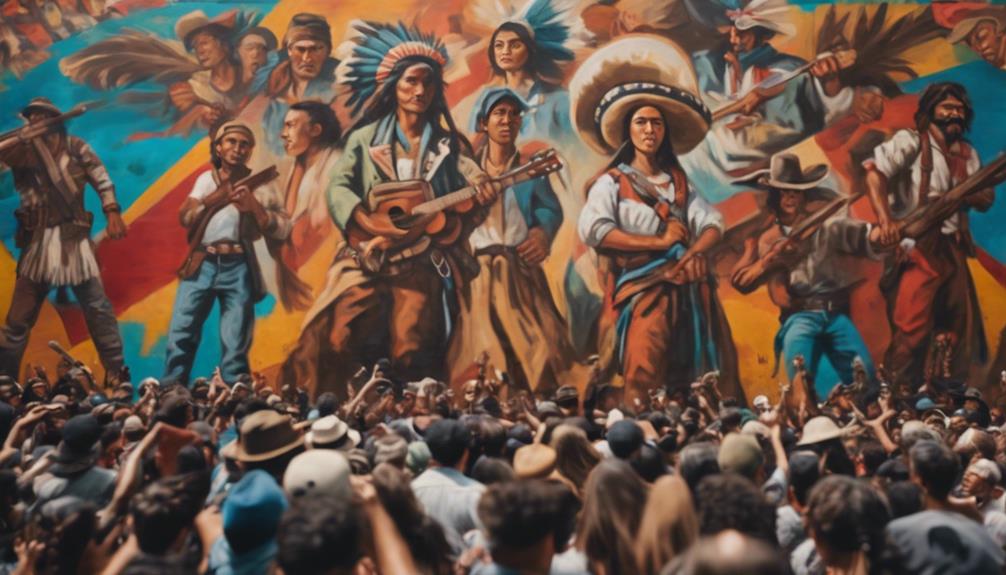
José Clemente Orozco’s ‘The Epic of American Civilization‘ masterfully illustrates the tumultuous collision of Indigenous and European cultures in the Americas. Created between 1932 and 1934 at Dartmouth College, this series of murals explores the profound impact of conquest, colonization, and cultural fusion.
Orozco’s dynamic style vividly portrays the violence and complexity of these historical events, making it a significant piece of art in the context of the Mexican muralist movement. As one of the prominent figures of this movement, Orozco’s work often reflected the themes and struggles associated with the Mexican Revolution.
‘The Epic of American Civilization’ doesn’t shy away from depicting the brutal realities faced by Indigenous cultures during European colonization. The murals encapsulate the ongoing struggle for identity and sovereignty in the Americas, a narrative deeply rooted in the history of Mexico.
At Dartmouth College, Orozco’s murals stand as a reflection of his powerful artistic vision. They invite you to reflect on the intertwined histories of Indigenous and European cultures and the lasting impact of their collision. This work remains a masterpiece of Mexican muralism and a compelling reflection on the broader human experience.
Frida Kahlo’s ‘The Two Fridas’
Frida Kahlo’s ‘The Two Fridas‘ poignantly captures her dual heritage and emotional turmoil following her divorce from Diego Rivera. Painted in 1939, this iconic artwork presents two versions of Kahlo seated side by side. One Frida wears traditional Mexican attire, symbolizing her indigenous roots, while the other dons a European-style dress, reflecting her mixed heritage and external influences.
In ‘The Two Fridas,’ Kahlo explores deeply into her identity and emotions. The two figures are connected by an artery, with their exposed hearts vividly illustrating their shared pain and connection. The Frida in the European dress holds surgical scissors, severing the artery, highlighting the emotional rupture from the divorce. The stormy sky in the background adds to the painting’s intense atmosphere, representing the inner turmoil Kahlo experienced.
This masterpiece is rich with symbolic elements, making it one of Kahlo’s most personal and profound works. It’s housed at the Museo de Arte Moderno in Mexico City, where it remains a tribute to her unique artistic vision and the complex interplay of her cultural heritage and personal struggles.
Through ‘The Two Fridas,’ you can deeply feel Kahlo’s heartbreak and resilience.
Rufino Tamayo’s ‘Dance of the Wind

Rufino Tamayo’s ‘Dance of the Wind‘ captivates viewers with its vibrant colors and dynamic forms, blending Mexican folk art with modernist influences. This masterpiece showcases Tamayo’s unique style, reflecting his deep exploration of Mexican culture and spirituality. The painting’s bold colors and abstract forms bring to life the essence of the Mexican Revolution, capturing the spirit of transformation and change.
In ‘Dance of the Wind,’ Tamayo explores universal themes such as nature, movement, and the human experience. The symbolic imagery and rich textures create a sense of depth and energy, making the artwork feel alive. His expressive brushwork conveys a rhythm and harmony that mirrors the natural world, embodying the essence of dance in a contemporary artistic language.
Tamayo’s work stands out for its ability to merge the traditional with the modern. By incorporating elements of Mexican folk art and infusing them with modernist influences, he creates a bridge between the past and the present.
‘Dance of the Wind’ isn’t just a visual feast; it’s a profound reflection on the interconnectedness of human experience, nature, and cultural identity during the Mexican Revolution.
Frequently Asked Questions
How Did the Mexican Revolution Impact the Arts?
You’d see how the Mexican Revolution reshaped the arts through revolutionary murals and artistic propaganda, integrating cultural symbolism, modernist influences, and folk traditions. Artists highlighted political themes, Indigenous representation, and national identity, sparking significant artistic movements.
What Are 5 Facts About the Mexican Revolution?
You’ll find that the Mexican Revolution saw Porfirio Díaz’s regime fall, revolutionary leaders like Pancho Villa and Zapata rise, agrarian reforms enacted, peasant revolts and regional conflicts intensify, and significant constitutional changes amid social upheaval and foreign intervention.
Who Were the Mexican Artists During the Revolution?
You’re asking about Mexican artists during the Revolution. Key figures included Diego Rivera, Frida Kahlo, David Siqueiros, José Orozco, Saturnino Herrán, Rufino Tamayo, Nahui Olin, María Izquierdo, and Ángel Zárraga. They profoundly influenced Mexican art.
Which Artist Experienced the Mexican Revolution?
You’d find that Diego Rivera experienced the Mexican Revolution firsthand. His revolutionary murals, rich in art symbolism and historical context, embody his political influence and cultural resurgence, shaping his artistic legacy and visual storytelling. Frida Kahlo shared this impactful era.
Conclusion
You’ve journeyed through the vibrant, tumultuous world of the Mexican Revolution via five incredible artworks. Each piece, from Rivera’s provocative ‘Man at the Crossroads’ to Tamayo’s mesmerizing ‘Dance of the Wind’, offers a unique lens on this transformative era.
You’ve seen how these artists captured the struggle, identity, and spirit of their times. Don’t just admire these works—let them inspire you to explore more about Mexico’s rich, revolutionary history and its lasting impact on art and culture.