

Difference Between Mezcal and Tequila: Things You Need To Know
When you think of Mexican spirits, you might lump mezcal and tequila together, but there are distinct differences that set them apart. Mezcal, often roasted in underground pits, offers a smoky, complex flavor, while tequila, made solely from Blue Weber Agave, features lighter, citrus-forward notes. These variations aren’t just about taste; they stem from unique production methods and cultural traditions. Curious about how these processes influence their flavors and why certain regions exclusively produce one or the other? Let’s uncover the fascinating intricacies behind these beloved spirits.
Key Takeaways
- Mezcal is made from various agave species, while tequila exclusively uses Blue Weber agave.
- Mezcal’s agave piñas are roasted in underground pits, whereas tequila’s are steamed in ovens or autoclaves.
- Mezcal has a smoky flavor profile, while tequila features lighter, citrus-forward notes.
- Mezcal production is predominantly artisanal, while tequila can be more industrialized.
- Mezcal is mainly produced in Oaxaca, while tequila primarily comes from Jalisco.
History of Mezcal and Tequila

The rich history of mezcal and tequila is deeply intertwined with Mexico’s cultural and indigenous traditions. Mezcal production dates back centuries, rooted in the craftsmanship and rituals of indigenous communities. This spirit, made from the agave plant, represents a substantial part of Mexico’s heritage.
Over time, mezcal’s production methods evolved, eventually giving rise to tequila in the 18th century, specifically in Jalisco.
Tequila’s journey from a local beverage to a globally recognized spirit was greatly influenced by key figures like the Cuervo family and Don Cenobio Sauza. These pioneers played pivotal roles in commercializing tequila and introducing it to international markets. Their efforts not only boosted tequila’s popularity but also highlighted its cultural importance.
In 1974, tequila was officially recognized as a Mexican designation of origin. This acknowledgment underscored its historical and cultural significance, protecting its authenticity in the spirits market.
Similarly, mezcal gained its designation of origin in 1994. This recognition solidified mezcal’s status alongside tequila, ensuring both spirits are celebrated and protected as unique products of Mexico’s rich traditions.
Production Methods
Exploring how mezcal and tequila are crafted reveals distinct processes that shape their unique flavors and characteristics.
In mezcal production, the agave piñas are roasted in underground pits lined with firewood and stones. This agave piña roasting process imbues mezcal with its signature smoky flavor.
Conversely, tequila production relies on agave piña steaming, using ovens or autoclaves, which produces a cleaner, consistent taste.
The choice of agave species also plays a vital role. Mezcal can be made from a variety of agave species, allowing for a broad spectrum of flavors. Tequila, on the other hand, is made exclusively from Blue Weber agave, leading to a more uniform flavor profile.
Mezcal production often employs artisanal methods and traditional techniques. This means much of the work is done by hand, with minimal use of machinery, maintaining a deep connection to its cultural roots.
Tequila production, however, can be more industrialized, focusing on efficiency and standardization.
Ultimately, these different production methods—agave piña roasting versus agave piña steaming, varied agave species, and artisanal versus industrial approaches—result in the distinctive qualities that set mezcal and tequila apart.
Regions of Production

When you look at where mezcal and tequila come from, you’ll notice their distinct geographic origins. Mezcal mainly hails from Oaxaca, but it’s also made in eight other Mexican states.
Tequila is mostly produced in Jalisco, with some regions in Guanajuato, Michoacan, Nayarit, and Tamaulipas also contributing.
Distinct Geographic Origins
Mezcal and tequila come from distinct regions in Mexico, each contributing unique characteristics to these iconic spirits. Mezcal and tequila have their roots deeply planted in specific Mexican states, with mezcal production mainly centered in Oaxaca and tequila production primarily in Jalisco.
Oaxaca, known for its diverse terroirs and traditional methods, is the heartland of mezcal production, with regions like Santiago Matatlán and Miahuatlán enriching the spirit with diverse flavors.
In contrast, tequila production is heavily concentrated in Jalisco, where the town of Tequila stands as the birthplace of this renowned beverage. While mezcal can legally be produced in nine Mexican states, including Guerrero, Durango, San Luis Potosí, and Zacatecas, Jalisco remains the primary hub for tequila, though it also enjoys production in parts of Guanajuato, Michoacán, Nayarit, and Tamaulipas.
The distinct geographic origins of mezcal and tequila play an important role in shaping their flavor profiles. Oaxaca’s traditional methods and varied landscapes create a wide range of mezcal flavors, while Jalisco’s established tequila production practices offer a more consistent taste.
Consequently, the regions of production play a significant role in shaping these beloved Mexican spirits.
Specific Regional Requirements
Understanding the specific regional requirements for producing mezcal and tequila is key to appreciating what makes each spirit unique. Tequila is primarily produced in Jalisco, but it can also come from certain regions in Guanajuato, Michoacán, Nayarit, and Tamaulipas. The Tequila Regulatory Council (CRT) guarantees that tequila meets strict geographical requirements, adhering to the Appellations of Origin. This regulatory framework assures that tequila maintains its authenticity and quality, tied closely to its designated regions.
On the other hand, mezcal production is more geographically diverse. It’s legally allowed in nine designated states, including Oaxaca, Guerrero, Durango, San Luis Potosí, and Zacatecas. Oaxaca, in particular, stands out as a significant hub for mezcal production. Specific regions within Oaxaca, such as Santiago Matatlán, Miahuatlán, and Ejutla, contribute to the diverse flavor profiles and production methods seen in mezcal. These geographical requirements ensure that mezcal, like tequila, remains true to its origins and maintains its distinct characteristics.
Both spirits owe their unique qualities to the specific regional requirements set forth by their respective Appellations of Origin, reflecting the rich cultural heritage of their designated production areas.
Agave Varieties
Tequila and mezcal differ significantly in the agave varieties used, with mezcal boasting up to 50 different species and tequila relying solely on Blue Weber Agave. This reliance on blue agave means tequila has a more limited agave variety compared to mezcal.
Mezcal production, on the other hand, leverages diverse agave families, such as Espadín, Tobalá, Arroqueño, Tepeztate, and Cuishe, which contribute unique flavor profiles to each mezcal.
The wide range of agave species used in mezcal results in remarkable flavor diversity. These agaves can impart flavors of roasted agave, tropical fruits, and sweet chocolates, offering a broad spectrum of tasting experiences. Mezcal’s use of various agave families and the distinct methods employed by different regions in Oaxaca further enhance its flavor diversity. Each region’s unique terroir influences the final product, allowing mezcal to capture a wide array of taste preferences, from ripe fruits to earthy undertones.
When you explore mezcal, you’re diving into a world rich with varied agave species, each bringing its own characteristics to the table. This contrasts sharply with tequila, where the exclusive use of blue agave limits its flavor spectrum.
Flavor Profiles

When comparing flavor profiles, you’ll notice mezcal’s smoky nuances contrast sharply with tequila’s lighter, citrus-forward notes. Mezcal presents a rich tapestry of flavors, often including tropical fruits, sweet chocolates, and earthy tones. These diverse taste experiences are largely due to the various agave varieties used in its production. Each type of agave contributes its unique characteristics, resulting in a spirit with complex and layered flavor nuances.
On the other hand, tequila typically offers a more straightforward flavor. Its profile leans towards a lighter body with distinct citrus-forward notes and the unmistakable essence of agave. The aging process in oak barrels can add depth to tequila, infusing it with hints of vanilla and caramel. These elements enhance its overall flavor without overshadowing its primary citrus and agave characteristics.
Both spirits can also showcase subtle floral notes, though these are often more pronounced in mezcal due to its broader range of flavor influences. The regional production in Oaxaca imparts mezcal with unique characteristics that make each batch a new adventure for your palate.
Whether you prefer the smoky depth of mezcal or the bright, citrus-forward profile of tequila, both offer distinct and delightful experiences.
Regulation and Standards
When it comes to regulations and standards, you’ll notice significant differences between mezcal and tequila.
Tequila must be produced in specific regions like Jalisco, while Mezcal’s production spans nine Mexican states.
Additionally, tequila has stricter rules on production methods and agave types, whereas mezcal offers more transparency with detailed labeling and a wider variety of agave species.
Geographic Production Areas
Understanding the geographic production areas of mezcal and tequila is essential for appreciating the distinct regulations and standards that define their authenticity.
Tequila, regulated by the Tequila Regulatory Council (CRT), must be made from Blue Weber Agave and produced within specific regions in Mexico, primarily Jalisco. This guarantees that only agave grown in these Appellations of Origin can be used, preserving the traditional methods and quality associated with tequila.
On the other hand, the Mezcal Regulatory Council (CRM) oversees mezcal production, which can occur in nine different states, including Oaxaca. Mezcal’s production isn’t limited to one type of agave; instead, it can be made from various agave species found in designated areas. This diversity in geographical regions allows mezcal to showcase a wide range of flavors and characteristics, rooted deeply in regional traditions.
Both spirits have their production areas strictly defined by their respective regulatory councils. These regulations not only safeguard the unique qualities and traditions of tequila and mezcal but also guarantee that what you’re drinking is authentically tied to its place of origin.
Aging and Classification
Just as the regions where they’re produced influence the flavors of tequila and mezcal, their aging and classification processes also play a critical role in defining their unique characteristics. Tequila aging categories are strictly regulated by Mexican law and include Blanco (unaged), Reposado (aged 2 months to a year), Añejo (aged 1-3 years), and Extra Añejo (aged more than 3 years). These regulations guarantee consistency in flavor profiles, with many enthusiasts gravitating towards Blancos for their authentic agave flavors.
Mezcal aging classifications can be slightly more varied. Typically, you’ll find Joven (unaged), Reposado (2 months to a year), Añejo (1-3 years), and Extra Añejo (more than 3 years). While tequila’s aging standards are more defined, mezcal aging allows for unique practices like aging in glass, which promotes oxidation and mellowing of flavors. This contributes to mezcal’s distinct and diverse taste experience, setting it apart from tequila.
Both spirits offer aged varieties that cater to different palates, but the trend in tequila consumption is shifting towards Blancos. This interest in unaged tequila highlights a growing appreciation for the pure, authentic agave flavors that are less altered by the aging process.
Agave Species Used
Tequila is strictly made from Blue Weber Agave, while mezcal boasts a rich diversity by using over 40 different agave species. This regulation guarantees that tequila delivers a standardized flavor profile, maintaining consistency across every bottle. The use of Blue Weber Agave in tequila creates a distinct and recognizable taste that fans of this spirit have come to expect.
On the other hand, mezcal thrives on diversity, thanks to the wide variety of agave species used in its production. With over 40 different agave species available, mezcal offers a broad spectrum of flavors and complexities. Each type of agave imparts its unique characteristics, resulting in unique flavor profiles that can range from earthy and smoky to sweet and floral.
Moreover, mezcal producers embrace transparency by typically detailing the agave variety used on their labels. This agave variety transparency allows you to understand and appreciate the specific agave species contributing to the drink’s flavor. The agave species variety in mezcal not only enhances its richness but also underscores the artistry behind its creation.
Aging Process

When it comes to aging, mezcal and tequila take different approaches that have a profound impact on their flavors. Mezcal can be aged in glass or wooden barrels, while tequila is exclusively aged in oak barrels. This distinction in the aging process results in unique flavor profiles for each spirit.
Tequila’s aging in oak barrels imparts characteristic vanilla and caramel notes. It offers specific aging categories:
- Reposado: Aged 2 months to a year.
- Anejo: Aged more than a year, up to three years.
- Extra Anejo: Aged more than three years.
- Blanco: Unaged, highlighting pure agave flavor.
In contrast, mezcal’s aging process can occur in glass, allowing for oxidation and mellowing of flavors without the influence of wood. This method preserves the agave’s natural essence while softening harsh edges. When aged in wooden barrels, mezcal can also develop complex flavors, though it’s less common than in tequila.
Understanding these aging differences helps you appreciate the diverse flavor profiles and complexity that each spirit brings to the table.
Whether you prefer the robust, woody notes of an anejo tequila or the pure, oxidized essence of a glass-aged mezcal, both offer compelling, distinct tasting experiences.
Consumption Styles
When it comes to consumption styles, you’ll find that mezcal and tequila offer distinct experiences. Mezcal is traditionally sipped neat to savor its complex flavors, while tequila is versatile enough to be enjoyed straight or in cocktails like Margaritas.
Modern trends have also introduced unique serving methods, such as pairing mezcal with orange slices and worm salt.
Neat Vs Cocktails
To fully appreciate mezcal’s complex flavors, it’s best enjoyed neat, whereas tequila often takes center stage in cocktail creations like Margaritas and Palomas. Mezcal is made with a focus on its rich, smoky, and intricate taste profiles, making neat consumption ideal for savoring these nuances.
On the other hand, tequila and mezcal offer distinct experiences depending on how they’re served. Tequila’s versatility in cocktails shines through its citrusy notes, which enhance traditional recipes. Mezcal cocktails, however, can add depth and complexity to mixed drinks, making them a unique choice for adventurous palates.
Here’s a quick comparison to guide your tasting experience:
- Neat Consumption: Mezcal’s complex flavors stand out more when enjoyed neat.
- Mixed Drinks: Tequila’s light and invigorating characteristics make it perfect for cocktails.
- Flavor Profiles: Mezcal offers smoky, intricate flavors; tequila provides citrusy, bright notes.
- Cocktail Use: Tequila is often used in classics like Margaritas; mezcal can elevate cocktails with its bold taste.
Exploring both spirits neat and in cocktails offers a well-rounded understanding of their unique qualities, allowing you to appreciate how they complement different drinking styles.
Traditional Serving Methods
Mezcal and tequila both have rich traditions that influence how they’re best enjoyed. When it comes to mezcal, the traditional serving method involves sipping it neat. This allows you to fully appreciate its complex flavors and aromas. Often, mezcal is served with orange slices and a side of sal de guano (worm salt), which enhances its unique taste profile. These accompaniments provide a balanced and authentic mezcal experience.
On the other hand, tequila has its own set of traditional serving methods. While aged tequilas are often sipped neat to savor their nuanced flavors, tequila shots are a popular choice, especially in the U.S. These shots are typically accompanied by salt and lime. The salt and lime help balance the strong flavors and create an invigorating experience.
Both mezcal and tequila find their way into cocktails, but their traditional nuances shine when enjoyed in their purest forms. Whether you prefer the smoky depth of mezcal or the varied profiles of tequila, understanding these traditional methods can enhance your tasting experience.
Modern Drinking Trends
You’ll find that modern drinking trends for mezcal and tequila are redefining how these spirits are enjoyed. Mezcal, traditionally consumed neat, is now gaining traction in the U.S. market with a rise in artisanal expressions and single-village offerings. This shift allows you to appreciate mezcal’s complex flavors fully, expanding your palate in ways you mightn’t have imagined.
Tequila, historically favorited in cocktails like Margaritas and Palomas, is also experiencing a renaissance. More enthusiasts are turning to unaged blancos and high-quality sipping tequilas to explore the nuanced flavors these spirits offer. This trend encourages a deeper appreciation of the craftsmanship behind tequila production.
Modern drinking trends highlight mezcal’s versatility, making it an exciting substitute for gin or vodka in classic cocktails. This provides a unique smoky twist that can elevate your drink experience.
As you explore different mezcals side by side, you’ll find yourself:
- Appreciating artisanal expressions
- Savoring single-village offerings
- Exploring the nuances of unaged blancos
- Enjoying high-quality sipping tequilas
These new consumption styles aren’t just about drinking but about discovering and savoring the diverse flavor profiles these spirits offer.
Price Comparison
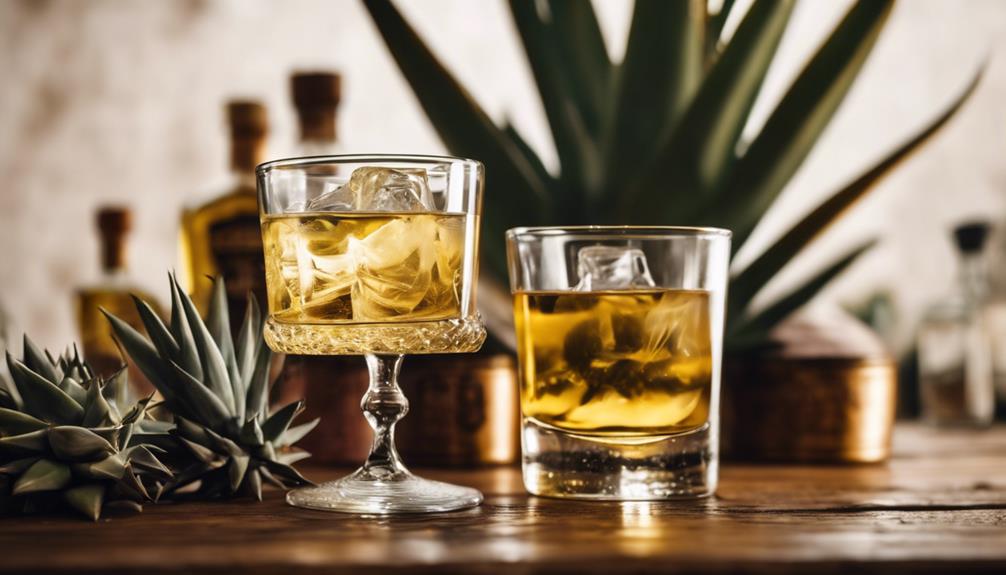
When comparing prices, you’ll generally find mezcal is more expensive than tequila due to its artisanal production and longer agave maturation time. Mezcal is handcrafted in small batches, which means each bottle often reflects a labor-intensive process. The scarcity of agave, resulting from its slow growth rate, adds to the higher price.
In contrast, tequila benefits from more commercialized production methods, leading to lower costs and more affordable pricing. Tequila’s production is often scaled up, making it easier to meet consumer demand without the same level of resource constraints. The commercialized nature of tequila production allows for economies of scale, considerably reducing overall costs.
On the other hand, mezcal’s smaller batch production and traditional methods mean that it can’t compete on price but justifies its cost through unique flavors and quality. The growing demand for mezcal, combined with its limited production capacity, further impacts its pricing. With mezcal, you’re paying for a distinctive experience rooted in tradition and craftsmanship.
Cultural Significance
Both tequila and mezcal hold profound cultural significance, deeply rooted in Mexican traditions and heritage. These spirits are more than just beverages; they embody a rich cultural history and a commitment to traditional craftsmanship. When you explore their origins, you’ll discover that tequila and mezcal are steeped in artistry and historical roots, reflecting the pride and dedication of those who produce them.
Mezcal, known for its artisanal process, is crafted entirely by hand without the use of machinery. This method has been passed down through generations, showcasing the deep respect for Mexican traditions and the rich cultural history that surrounds it. The dedication to preserving these methods highlights the commitment to traditional craftsmanship.
Tequila, on the other hand, is considered one of the oldest spirits in the world, with a heritage dating back centuries. Its production also involves a high level of artistry and cultural pride.
By understanding the cultural significance of these spirits, you can appreciate:
- The meticulous artisanal process of mezcal.
- The centuries-old heritage of tequila.
- The historical roots that define both spirits.
- The deep-seated commitment to traditional craftsmanship.
Both spirits are cherished symbols of Mexican cultural identity.
Frequently Asked Questions
Is Mezcal Stronger Than Tequila?
You might think mezcal’s stronger due to its smoky flavor profile, but it depends on alcohol content. Mezcal and tequila vary by production process, agave varieties, distillation method, aging period, and geographic origin. Drink responsibly!
Why Does Mezcal Not Give You a Hangover?
Mezcal’s organic production and additive-free methods, combined with high agave quality and traditional distillation methods, result in a purer drink. The natural yeast fermentation process and Anejo aging can lead to fewer hangover symptoms.
Why Is Mezcal so Special?
Mezcal’s special because its unique production uses traditional methods and artisanal craftsmanship. You’ll taste a smoky flavor and diverse varieties. Its cultural significance, aging process, and regional differences make each bottle a true Mexican treasure.
Is Mezcal a Sipping Tequila?
Mezcal isn’t a sipping tequila; it’s a distinct spirit. Its aging process, regional differences, unique flavor profile, diverse agave varieties, craft production, specialized distillation methods, smoke influence, and rich historical background make it truly special for sipping.
Conclusion
So, when you’re choosing between mezcal and tequila, remember that mezcal offers smoky, complex flavors from various agave species, while tequila provides lighter, citrusy notes from Blue Weber Agave.
Both reflect rich cultural traditions and distinct production methods.
Whether you prefer the earthy depth of mezcal or the bright, smooth taste of tequila, you’re savoring a piece of Mexico’s heritage.
So, grab a glass, take a sip, and enjoy the journey through these iconic spirits.